
Why Your Account Manager Can’t Answer Basic Questions About Your Campaign

Why Marketing Agency Can’t Answer Basic Questions
You’re on a call with your agency account manager. You ask a straightforward question: “What’s our current cost per lead?” There’s a pause. “I’ll need to check on that and get back to you.”
You try another: “When was the last time we tested new ad creative?” Another pause. “I believe we’re running some tests. Let me confirm the details.”
By the third question, “Why are we focusing on this platform instead of that one?” the pattern is unmistakable. Your account manager doesn’t actually know what’s happening with your campaigns.
This isn’t just frustrating. It’s a signal. When the person supposedly managing your marketing investment can’t answer basic questions about your account, it reveals something important about how your campaigns are really being handled.
This article will explain why this happens, what questions every account manager should be able to answer, and what you should do about it.
Why Your Account Manager Doesn’t Know
The inability to answer basic questions about your campaign isn’t usually about incompetence. It’s about structural problems in how agencies operate.
Account Capacity Overload
Junior staff juggling 15-20+ accounts simultaneously simply cannot maintain detailed knowledge of each one. At that volume, your account manager might spend a few hours per month on your business, total. That’s not enough time to know your campaigns intimately.
When you’re one of twenty accounts, your account manager is constantly context-switching. They were in your Google Ads account this morning, then a different client’s Meta campaigns, then another client’s SEO report. By the time you call, they need to mentally reload your business, your industry, your campaigns, and your current priorities.
The math is unforgiving. If an account manager works 160 hours per month and handles 20 accounts, that’s 8 hours per account. Subtract meetings, admin, reporting, and other overhead, and actual hands-on campaign time might be 3-4 hours monthly. Not enough to know your account deeply.
Limited Involvement in Strategy
Many account managers are execution-focused, not strategy-focused. They implement what others decide. The senior strategist who set up your campaigns may have moved on to other projects (or other clients). The person now “managing” your account may never have understood the strategic reasoning behind the decisions.
When you ask “why are we doing this?” they genuinely don’t know. They inherited a campaign structure without the context of how it was designed or what it was meant to achieve.
Junior Staff Limitations
The experienced professionals who sold you have disappeared, replaced by inexperienced juniors who struggle to answer basic questions about your industry or campaign strategy.
One agency claimed deep e-commerce expertise during their pitch. But when I asked the assigned account manager specific questions about Shopify integration, they had to “check with the team” on basic functionality. It became clear they had one e-commerce specialist who did pitches while everyone else was learning on the job.
This pattern is common. Senior staff sell, junior staff execute. The person answering your questions may have been with the agency for just weeks or months, managing your account as on-the-job training.
The Handoff Problem
Agency turnover compounds the knowledge gap. Marketing agencies experience turnover rates of approximately 30% annually, among the highest of any professional industry. This means nearly a third of the workforce changes each year.
When your previous account manager left, how much knowledge transferred to the new one? Usually very little. The new person has access to your campaigns but limited understanding of their history, the decisions made, the tests run, or the lessons learned.
You’re constantly re-educating new account managers, repeating your business basics, while paying full price for “management” that amounts to someone else’s learning curve.
For more on the handoff problem, see our detailed breakdown of the agency bait-and-switch.
The Test: Questions Every Account Manager Should Know
Here’s a simple test. Ask your account manager these questions. Their ability (or inability) to answer reveals how closely your account is actually being managed.
“Why are we using this platform instead of alternatives?”
What they should say: A clear explanation tied to your business goals, target audience, and competitive landscape. “Your customers are primarily B2B decision-makers in the 35-55 age range, which is LinkedIn’s core demographic. We tested Meta initially but CPLs were 40% higher with lower lead quality.”
What non-answers reveal: If they can’t explain platform selection, they didn’t make the decision and may not understand the reasoning. They’re executing a playbook without knowing why.
“What’s our current cost per lead (or cost per acquisition)?”
What they should say: The specific number, ideally from memory or with quick reference. “Your CPL last month was £47, down from £62 the month before. We’ve been optimising toward the high-intent audience segments.”
What non-answers reveal: If they don’t know your key metrics, they’re not monitoring performance closely. Your campaigns may be running on autopilot without active oversight.
“When was the last significant optimisation you made?”
What they should say: A specific, recent example with clear reasoning. “Two weeks ago, we paused the underperforming ad set targeting interest-based audiences and reallocated budget to the lookalike that’s converting at 3x the rate.”
What non-answers reveal: Vague answers like “we’re continuously optimising” or “I’d need to check” suggest minimal active management. Real optimisation is memorable. If they can’t recall recent changes, there probably haven’t been any.
“What are our top-performing keywords or ads?”
What they should say: Immediate, specific answers. “Your top three converting keywords are [specific terms]. The winning ad is the one with the case study headline, converting at 4.2%.”
What non-answers reveal: Not knowing top performers means not knowing what’s working. How can they scale success if they don’t know what’s succeeding?
“What tests are currently running?”
What they should say: Details of active experiments. “We’re testing two new headlines against the control. Also running a landing page variant test that started Monday, expected to reach significance by end of next week.”
What non-answers reveal: If nothing is being tested, nothing is being improved. Testing is the engine of optimisation. No tests means stagnation.
“What’s the plan for next month?”
What they should say: Specific initiatives tied to your goals. “We’re launching the new product campaign on the 15th, expanding into the new geographic target you approved, and testing video creative for the first time.”
What non-answers reveal: If there’s no plan, your account is reactive at best, neglected at worst. Proactive management requires forward planning.
Concerned Your Account Manager Doesn’t Know Your Account?
I can assess how closely your campaigns are actually being managed and identify whether you’re getting the attention you’re paying for.
Request Your Free Management Assessment →
Free Download: Report by an Ex-Agency Owner
7 Alarming secrets marketing agencies hope you never discover
Download Free Ebook →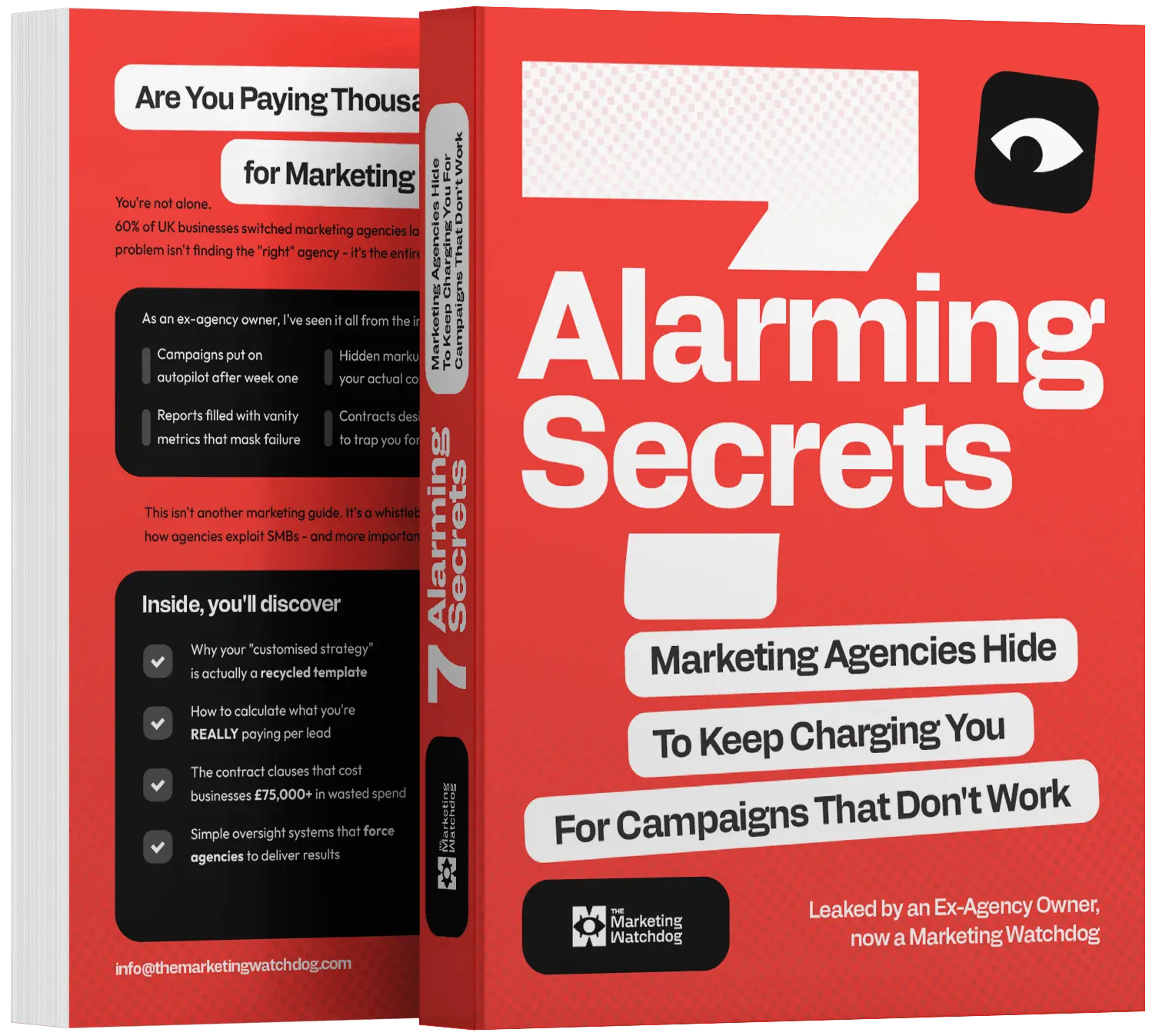
The Impact of Knowledge-Less Management
When your account manager can’t answer basic questions, it’s not just an inconvenience. It has direct consequences for your marketing results.
Strategic Decisions Being Missed
When your campaigns are managed by staff without the promised expertise, the consequences are significant. Strategic opportunities go unidentified. Platform-specific optimisations never happen. Industry-specific nuances are missed.
Someone who doesn’t understand your campaigns can’t spot opportunities within them. They follow the playbook without recognising when to deviate from it. Market changes, competitor moves, and emerging opportunities pass unnoticed.
Optimisations Not Happening
When I showed one client how their budget had been allocated versus where their customers actually converted, they were obviously surprised. Over 60% of their spend had gone to keywords and audience segments that historically produced zero sales or contributed to sales at any of the funnel stages.
This wasn’t malicious. It was simply what happens when inexperienced account managers follow generalised playbooks without deeper strategic understanding. It’s okay to experiment, but there has to be a hypothesis behind it and an actual plan.
Your budget funds someone else’s learning curve while campaigns follow generalised “best practices” rather than tested strategies for your specific business.
Your Business Treated as Template
Witnessing this scenario, campaigns managed by agencies with textbook structures that were completely wrong for the client, became my nearly weekly routine.
When account managers don’t know your business deeply, they default to templated approaches. Your campaigns look like every other client’s. Your industry specifics are ignored. Your competitive advantages aren’t leveraged. You become a line item to be processed rather than a business to be grown.
Technical issues go undiagnosed. Problems with tracking, attribution, or platform configuration can persist for months because no one is looking closely enough to notice. By the time issues surface, they’ve cost you significant budget.
Learn more about how campaigns get put on autopilot while you continue paying full fees.
Addressing the Knowledge Gap
If your account manager consistently can’t answer basic questions, you have options. Here’s how to address the situation.
Escalation Options
Start with a direct conversation. Express your concern that your account manager doesn’t seem to have detailed knowledge of your campaigns. Ask to understand the account structure: who makes strategic decisions, who executes, and how much time is actually being allocated.
If the response is unsatisfactory, escalate. Request a meeting with the senior strategist or director who sold you the account. Ask them to explain why the day-to-day contact lacks basic knowledge. Their response will tell you whether this is a correctable issue or a fundamental problem with how they operate.
Be specific about your concerns: “I’ve asked several questions about my campaigns, and the account manager had to ‘check with the team’ each time. I need to understand why the person managing my account doesn’t know what’s happening with it.”
Documentation to Request
Ask for documentation that demonstrates active management:
Change logs: Most advertising platforms track when changes are made and by whom. Request this history. Long gaps between changes suggest autopilot. And make sure you have direct access to your own data; learn about the excuses agencies use to avoid accountability when you ask for access.
Optimisation records: Ask for a summary of all changes made in the past 90 days, with the reasoning for each. If they can’t produce this, those changes probably didn’t happen.
Test history: Request documentation of tests run, hypotheses tested, and results. Active management leaves a trail. Neglect leaves silence.
Time allocation: Some agencies track time by client. Ask how many hours have been allocated to your account monthly. Compare this to what you’re paying, and watch for hidden fees that inflate your costs without adding value.
When to Demand Change
If documentation reveals minimal activity, or if your account manager still can’t answer basic questions after you’ve raised concerns, it’s time to demand change.
Request a new account manager with more experience or fewer accounts. Insist on senior oversight guarantees in writing. Demand regular documented reporting on optimisations made, not just results achieved.
If the agency won’t accommodate reasonable requests for transparency and competent management, consider whether the relationship is worth continuing.
The Independent Oversight Option
Having observed this pattern across hundreds of agency relationships, I’ve found that independent oversight often reveals issues agencies won’t acknowledge themselves.
An independent audit can verify whether your campaigns are being actively managed, whether the account manager’s claims match platform reality, and whether your budget is being allocated effectively. It’s the difference between trusting what you’re told and knowing what’s actually happening.
For technical specialities like PPC or SEO, platform-specific credentials matter. Confirm that your account manager holds relevant certifications and has appropriate experience. It’s not a guarantor of success, but you at least know they’ve passed the theory.
If you’re consistently getting non-answers, there’s probably a reason. Don’t accept “I’ll get back to you” indefinitely. Your marketing investment deserves better.
You Deserve Answers
Your account manager should know your campaigns. Not everything, but the fundamentals: what’s working, what’s not, what’s being tested, what’s planned. These aren’t trick questions. They’re the basics of active management.
If basic questions consistently result in “let me check on that,” it’s a signal. Either your account manager is overloaded, undertrained, or not actually working on your account. None of those options justify full management fees.
Ask the questions. Demand the documentation. And if the answers don’t come, consider getting an independent marketing audit.
Your marketing budget is too important for “I’ll get back to you.”
Find Out If Your Account Is Really Being Managed
Request Your Free Account Activity Audit
I’ll assess whether your campaigns are receiving genuine attention or running on autopilot with an overloaded, undertrained account manager.
What You’ll Receive:
- Review of account activity and change history
- Assessment of optimisation frequency
- Evaluation of test activity
- Recommendations for accountability
This post is part of a comprehensive series on holding your marketing agency accountable. Learn more about the agency bait-and-switch where senior staff sell and junior staff execute and discover how agencies put campaigns on autopilot while charging full fees.
Stop Guessing. Start Knowing.
Get your free marketing assessment and find out what's really happening with your agency spend.
Get in Touch →