
Vanity Metrics vs. Business Metrics: What Your Agency Report Should Actually Show

- What Your Agency Report Should Actually Show
- What Are Vanity Metrics?
- The Vanity Metrics You're Probably Seeing
- Metrics That Actually Impact Your Bottom Line
- Why Your Agency Reports What They Report
- How to Get Reports That Matter
- Red Flags in Your Agency Reports
- Time to Demand What Matters
- Get Reports That Actually Matter
What Your Agency Report Should Actually Show
If you’ve been working with a marketing agency for any length of time, you’re probably familiar with this monthly ritual: receiving an impressive-looking report filled with charts, graphs, and numbers that all seem to be pointing upward.
The agency account manager walks you through it with enthusiasm, highlighting terms like “impressions,” “reach,” “engagement rate,” “leads,” and “follower growth.”
You leave the meeting feeling reasonably good. After all, the numbers are going up!
But weeks or months later, you find yourself asking a simple question: “If all these metrics are improving, why isn’t my business growing accordingly?”
This disconnect reveals what I call the “Vanity Metric Smokescreen,” one of the most effective tactics agencies use to maintain retainers while delivering minimal business impact. Don’t you feel like the most important metrics are missing?
My article will clarify the critical difference between vanity metrics (which look impressive but mean nothing) and business metrics (which actually impact your bottom line). You’ll learn to identify which metrics matter, why agencies favour the ones that don’t, and how to demand reporting that tells you whether your marketing investment is actually working.
Because at the end of the day, your marketing should be accountable for results that affect your business, not just numbers that look good in a presentation.
What Are Vanity Metrics?
Vanity metrics are statistics that appear impressive at first glance but lack a substantive connection to your business objectives.
They’re usually easy to measure, simple to manipulate, and create a positive impression. However, they fail to correlate with tangible outcomes like revenue, customer acquisition, or profitability.
According to research, vanity metrics are characterised by several key traits:
The 4 Characteristics of Vanity Metrics
1. Superficially Impressive
They often involve large numbers that create an illusion of success (e.g., thousands of followers, page views, or likes). Big numbers feel like progress, even when they contribute nothing to your bottom line.
2. Easy to Measure and Manipulate
They can be tracked using standard analytics tools and sometimes inflated through tactics that don’t drive real value. Want more followers? You can buy them. Want more impressions? Broaden your targeting until it’s meaningless.
3. Lack Substance and Context
They rarely provide insight into why something is happening or what specific actions should be taken next. A report showing “impressions up 40%” tells you nothing about whether those impressions led to interest, enquiries, or sales.
4. No Direct Link to Business Objectives
Most critically, they don’t translate into core business outcomes such as revenue, customer acquisition cost (CAC), customer lifetime value (CLTV), or return on investment (ROI).
One business owner in my research expressed his frustration perfectly:
“Agencies talk about impressions and clicks, but never tie their work back to actual sales. I need to know how marketing impacts my bottom line.”
This frustration is widespread. Business owners want to understand the connection between what they’re spending and what they’re getting in return. Vanity metrics deliberately obscure that connection.
The Vanity Metrics You’re Probably Seeing
Let’s examine the metrics that frequently appear in agency reports and why they often mean very little for your business.
Social Media Followers and Likes
A large follower count might look impressive, but it’s meaningless if your audience isn’t interacting or converting. My experience and research reveal that high numbers of likes or followers can be easily inflated through methods like purchasing followers or running contests targeting non-customers.
One study I analysed highlighted a particularly telling case: a business achieved actual sales from Instagram content with just ~30 views, while another client’s “viral” content generating hundreds of thousands of views resulted in zero sales. These high numbers “didn’t make them a dime.”
The question isn’t how many followers you have. It’s how many of those followers become customers.
Impressions and Reach
“Your ad was seen by 50,000 people this month!” Agencies love to report this metric. However, research shows that impressions and reach merely indicate potential audience size, not whether people took action or if exposure led to tangible results like website visits or sales.
It’s quite simple to understand that over-reliance on impressions, especially in paid campaigns, is often a red flag if not tied to engagement or conversion metrics. One case study showed an agency bragging about a low cost per view (CPV) of £0.0037, initially exciting the client, but the campaign ultimately failed to generate the necessary revenue.
Impressions tell you how many times something was displayed. They tell you nothing about whether anyone cared.
Website Pageviews and Time on Site
More website traffic seems positive, but not all traffic is created equal. Research shows agencies sometimes drive unqualified traffic to websites through clickbait tactics or irrelevant keywords merely to boost this number.
Similarly, a high average time on site can sometimes indicate user confusion or difficulty in finding desired information, rather than deep engagement. Without correlation to conversion rates, these metrics remain superficial.
If your traffic is up but your sales are flat, you might be experiencing exactly this problem. Discover why marketing reports can look great while sales stay flat.
Email Open Rates
Research indicates that open rates have become increasingly unreliable due to privacy changes (like Apple’s Mail Privacy Protection), and technical factors that can artificially inflate or deflate these numbers.
An agency might report “45% open rate” as a success, but if those opens aren’t translating to clicks, enquiries, or sales, the metric is essentially meaningless. List size suffers from the same problem: a list of 50,000 disengaged subscribers is worth less than 500 genuinely interested prospects.
Engagement Rate (Without Context)
Engagement metrics like comments, shares, and reactions can be valuable, but only when connected to business outcomes. An engaging post that generates discussion but no leads or sales is entertainment, not marketing.
The principle is simple: likes don’t pay bills. Unless engagement leads to conversion, it’s vanity.
Metrics That Actually Impact Your Bottom Line
I’ve identified the key metrics that SMBs should actually focus on. These are the numbers that tell you whether your marketing is genuinely working.
Revenue Metrics
Return On Ad Spend (ROAS)
For every £1 you put into marketing, how many pounds do you get back? This directly measures the profitability of your marketing activities. My personal experience and especially research indicates that anything less than 2:1 is typically unsustainable for most businesses (not applicable to some ecommerce businesses).
Marketing-Attributed Revenue
This involves tracking and assigning revenue generated directly or indirectly by specific marketing activities. This provides the clearest link between marketing investment and top-line business growth.
Cost Metrics
Cost Per Acquisition (CPA) / Customer Acquisition Cost (CAC)
This measures the total cost to acquire a paying customer through your marketing campaigns.
If you want to analyse the value of a marketing agency, the true CPA must include all associated costs, not just ad spend. This encompasses agency management fees, software costs, and the cost of internal staff time dedicated to the campaign. A sustainable CPA should be significantly lower than your Customer Lifetime Value.
Learn how to calculate your true cost per lead including all hidden costs.
Cost Per Lead (CPL) and Cost Per Qualified Lead
Understanding what you pay for each lead, and specifically for each qualified lead, gives you clarity on funnel efficiency. The distinction matters: 100 leads at £10 each is worse than 20 qualified leads at £40 each if those qualified leads actually convert.
Conversion Metrics
Conversion Rate
What percentage of leads/visitors turn into actual sales? If this number isn’t improving over time, likely something’s wrong with your marketing funnel. Tracking conversion rates by channel reveals which marketing activities are most effective at driving valuable actions.
Lead Quality Metrics (MQL/SQL)
Tracking Marketing Qualified Leads (MQLs) and Sales Qualified Leads (SQLs) provides insight into the health of your sales funnel. Monitoring the conversion rate from MQL to SQL is quite crucial for assessing lead quality and the alignment between marketing and sales efforts.
Please note, it is really important to get marketing and sales teams aligned as often as reasonably possible, especially for lead-focused businesses.
Customer Value Metrics
Customer Lifetime Value (CLTV)
How much is each customer worth over their entire relationship with your business? This metric contextualises your acquisition costs and helps determine sustainable CPA targets.
CAC:CLTV Ratio
The relationship between what you spend to acquire a customer and what that customer is worth. A healthy ratio is typically 1:3 or better.
Free Download: Report by an Ex-Agency Owner
7 Alarming secrets marketing agencies hope you never discover
Download Free Ebook →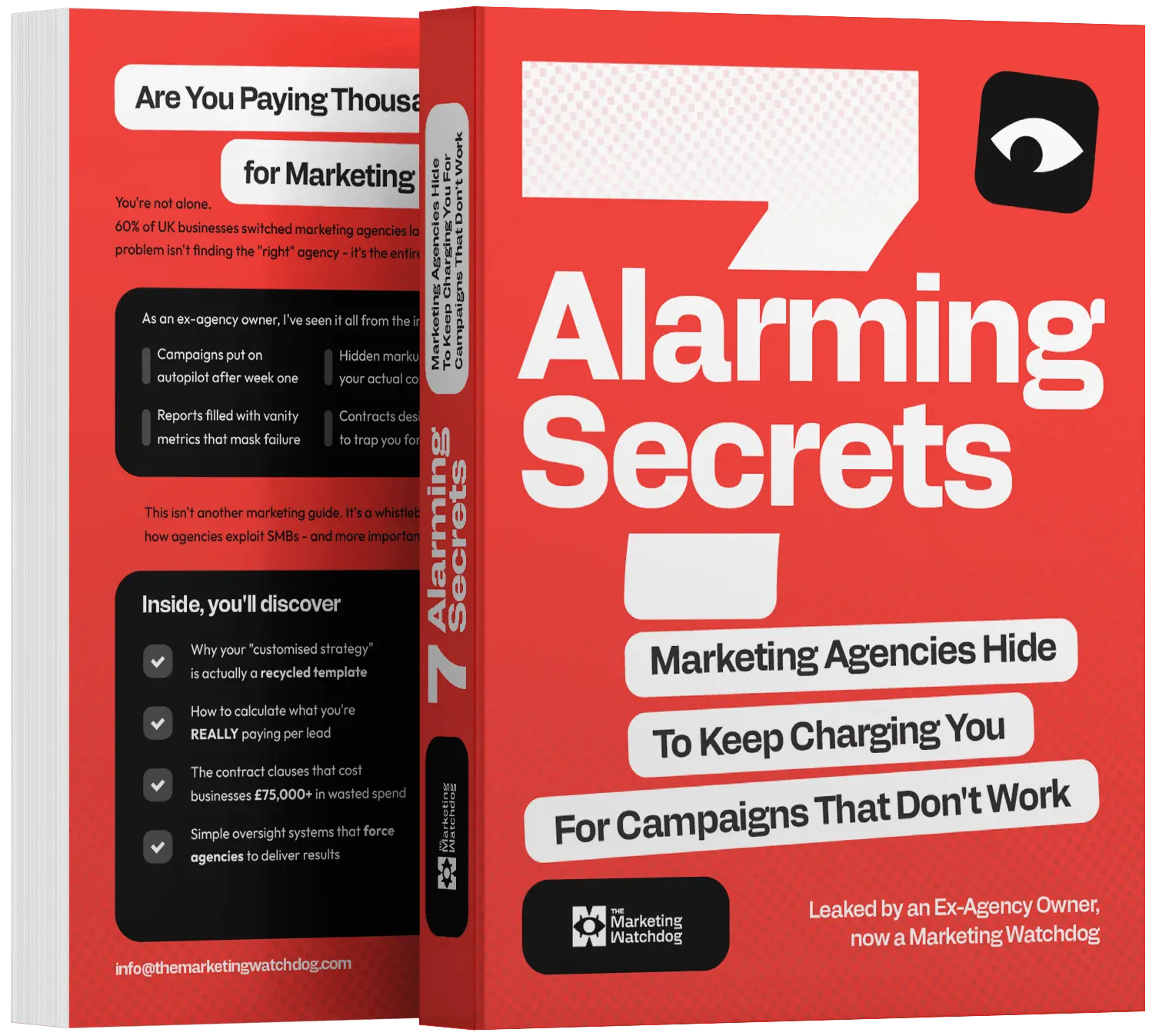
Vanity vs. Business Metrics: The Comparison
| Vanity Metrics | Business Metrics |
|---|---|
| Followers/Likes | Marketing-Attributed Revenue |
| Impressions/Reach | Return on Ad Spend (ROAS) |
| Page Views | Cost Per Acquisition (CPA) |
| Email Open Rates | Customer Lifetime Value (CLTV) |
| Engagement Rate | MQL to SQL Conversion Rate |
| Time on Site | CAC:CLTV Ratio |
The left column looks impressive in reports. The right column tells you whether your business is actually growing.
Not Sure Which Metrics Matter for Your Business?
I can review your agency’s reporting and identify whether you’re getting vanity metrics or genuine business intelligence.
Request Your Free Metrics Audit →
Why Your Agency Reports What They Report
Here are several reasons why marketing agencies prioritise vanity metrics:
1. Obscuring Poor Performance
When campaigns fail to generate qualified leads, sales, or a positive ROI, agencies shift focus to easily achievable metrics like impressions or follower growth to create an illusion of success. Learn more about the tactics agencies use to hide poor performance.
It’s much easier to show a graph going up and to the right when you’re measuring something that always goes up. Impressions can always be increased by spending more. Followers can always be grown with the right tactics. But sales? Those require actual marketing effectiveness.
2. Ease of Influence and Reporting
Vanity metrics are often simpler to influence and report than bottom-line results. Increasing likes or pageviews can be achieved with less strategic effort than improving conversion rates or lowering customer acquisition costs.
This matters because agency staff are often stretched thin. It’s easier to produce a report showing activity metrics than to demonstrate genuine business impact.
3. Impressing Less Knowledgeable Clients
Large numbers related to reach or engagement can seem successful to business owners unfamiliar with how these metrics correlate (or fail to correlate) with actual business impact.
When your agency says “We achieved 2 million impressions this month,” it sounds impressive. Most business owners don’t know to ask “And how many of those impressions became customers?”
4. Justifying Fees and Retainers
Particularly in retainer-based models, reporting on activity metrics helps justify ongoing fees, even when those activities aren’t driving bottom-line results.
“Look at all this work we’ve done” is a much easier conversation than “Here’s the return on your investment.”
The Gaslighting Problem
One SMB owner (from reddit) reported feeling “gaslit” when agencies dismissed concerns about poor ROAS by emphasising engagement figures. This disconnect often stems from a fundamental misalignment in how “success” is defined by the agency versus the client.
When you raise concerns about ROI and the agency responds by pointing to followers or impressions, they’re deflecting. They’re hoping you’ll accept metrics that make them look good instead of metrics that tell you whether your investment is paying off.
How to Get Reports That Matter
Based on my experience, here’s how to ensure you’re not being blinded:
Establish Clear Business Objectives From Day One
Don’t let your agency define success. You tell them what actual business outcomes you need. According to the research, these should be specific, measurable, and directly tied to revenue or profitability.
For example: generate X qualified leads per month at a cost of £Y per lead, achieve a ROAS of 3:1, or increase online sales by Z% within 3 months.
Yes, it is that simple. Ignore the friction; just demand this to be the primary objective.
Demand Reports That Tie Directly To Revenue
Businesses should insist that reporting prioritises metrics directly connected to the bottom line, with vanity metrics used only for secondary context.
Your monthly report should answer one fundamental question: is our marketing investment generating a positive return? Everything else is supplementary.
Get Direct Access To Your Data
Reluctance to grant clients direct access to analytics and advertising platforms is a major red flag. Demand read-only access to your accounts (Google Analytics, Google Ads, Meta Ads Manager, etc.) to independently verify the data. Google’s free analytics training on Skillshop can help you learn to read your own data.
Calculate The True Cost Per Lead
Ensure you’re calculating the real cost of each lead by including all expenses, not just media spend, but also agency fees, technology costs, and internal resources. This gives you a much clearer picture of your marketing efficiency from a macro perspective.
Question Everything
When presented with impressive-looking metrics, always ask: “How does this impact my bottom line?” If the connection is tenuous or the agency struggles to explain it clearly, be suspicious.
For guidance on the metrics UK business owners actually need to track, see our comprehensive breakdown.
Red Flags in Your Agency Reports
Be vigilant for these warning signs in your agency reporting:
- Heavy focus on followers, likes, shares, impressions, or pageviews without demonstrating their impact on conversions or sales
- Metrics presented in isolation, without comparison to business goals or previous performance
- Reports showcasing impressive top-level numbers but failing to drill down into conversion performance or cost-effectiveness
- Consistent omission or downplaying of critical metrics like CPA, ROAS, or marketing-attributed revenue
- Reluctance to grant you direct access to your analytics and advertising platforms
If your reports consistently avoid discussing cost per acquisition, return on ad spend, or marketing-attributed revenue, that’s not an oversight. It’s a strategy. Our guide to reading marketing reports properly breaks down what to look for.
As one business owner aptly put it:
“I need to know that my marketing budget is being spent wisely and that the agencies I work with are actually helping my business grow. I want clear results and honest communication, not just empty promises.”
Time to Demand What Matters
The next time you receive a report filled with impressive-looking numbers, ask yourself this simple question: “Can I pay my bills with page views and likes?”
If the answer is no, it’s time to demand metrics that truly matter.
Your marketing investment should be accountable for actual business results, not just activity that looks good in a PowerPoint presentation. Every pound you spend deserves a clear answer: did it contribute to growing your business, or did it just generate numbers that made the agency look busy?
The difference between vanity metrics and business metrics is the difference between feeling good about your marketing and knowing your marketing is working.
Choose knowing.
Get Reports That Actually Matter
Request Your Free Metrics Review
I’ll analyse your current agency reporting and identify whether you’re getting vanity metrics or genuine business intelligence.
What You’ll Receive:
- Assessment of your current reporting quality
- Identification of missing business metrics
- Recommendations for what to demand
- Template for metric requirements
This post is part of a comprehensive series on holding your marketing agency accountable. Learn more about why reports look great while sales stay flat, discover the essential ROI metrics for UK SMBs, and understand how to calculate your true cost per lead.
Stop Guessing. Start Knowing.
Get your free marketing assessment and find out what's really happening with your agency spend.
Get in Touch →