
The Warning Signs Your Agency Doesn’t Understand Your Industry

You Explained It. Three Times.
You’ve walked them through the buying cycle. You’ve explained why the summer is quiet and why nobody signs anything in the fortnight before year end. You’ve told them which claims you’re not allowed to make.
And the work still comes back generic.
Owners usually read that as a communication failure and try explaining again, more slowly, with a document this time. It rarely helps, because the problem was never that they didn’t hear you.
Most agencies describe themselves as full-service. Very few have genuine depth across every sector they take on, and admitting a gap costs them the account. So they reach for the tactics they know well and apply them to whoever walks through the door. The output looks professional. It just isn’t aimed at your market.
This page covers how to confirm that’s what’s happening, what it costs, and what to do about it.
Six Signs, and How to Check Each One
Suspicion is easy here. Every owner has a feeling about this. What follows turns the feeling into something you can verify in an afternoon.
- The advice would suit anybody. Build your social presence. Improve conversion rate. Invest in content. The check: take their last three recommendations, delete your company name, and ask whether you could send them unchanged to a business in a completely different sector. If you could, they weren’t written for you.
- Nobody asked about your industry at the start. The check: go back to the onboarding questionnaire and count the questions that could only have been asked of a business like yours. Margins, sales cycle, objections, regulation, seasonality. If the count is zero, the account was set up from a template.
- The words are wrong. The check: hand a piece of their copy to your best salesperson and ask whether they’d say it out loud to a customer. They’ll tell you in about four seconds, and they’ll be right. Your buyers hear the same thing your salesperson does.
- Spend ignores your calendar. The check: put monthly ad spend next to monthly revenue for the last year. A flat spend line against a seasonal revenue line means nobody is planning around how your market actually buys.
- The case studies are from somewhere else. A luxury spa offered as evidence for industrial parts. The check: ask for one from your sector. Not a similar one. Yours. Watch what happens next.
- You flagged a compliance problem and nothing changed. The check: find the message where you raised it, then look at the next two deliverables. “We’ll take that under advisement” followed by identical output is the clearest signal on this list.
One example that has stayed with me. I’ve watched agencies with real expertise in Facebook advertising recommend Facebook-first strategies to B2B industrial manufacturers whose buyers simply aren’t on the platform. They knew their channel inside out. They didn’t know the client’s industry, and nobody in the room could tell the difference between those two things.
An agency insider once put the underlying habit to me plainly: “We nod and smile when clients make suggestions, then do what we planned anyway. Most don’t notice the difference.”
Free Download: Report by an Ex-Agency Owner
7 Alarming secrets marketing agencies hope you never discover
Download Free Ebook →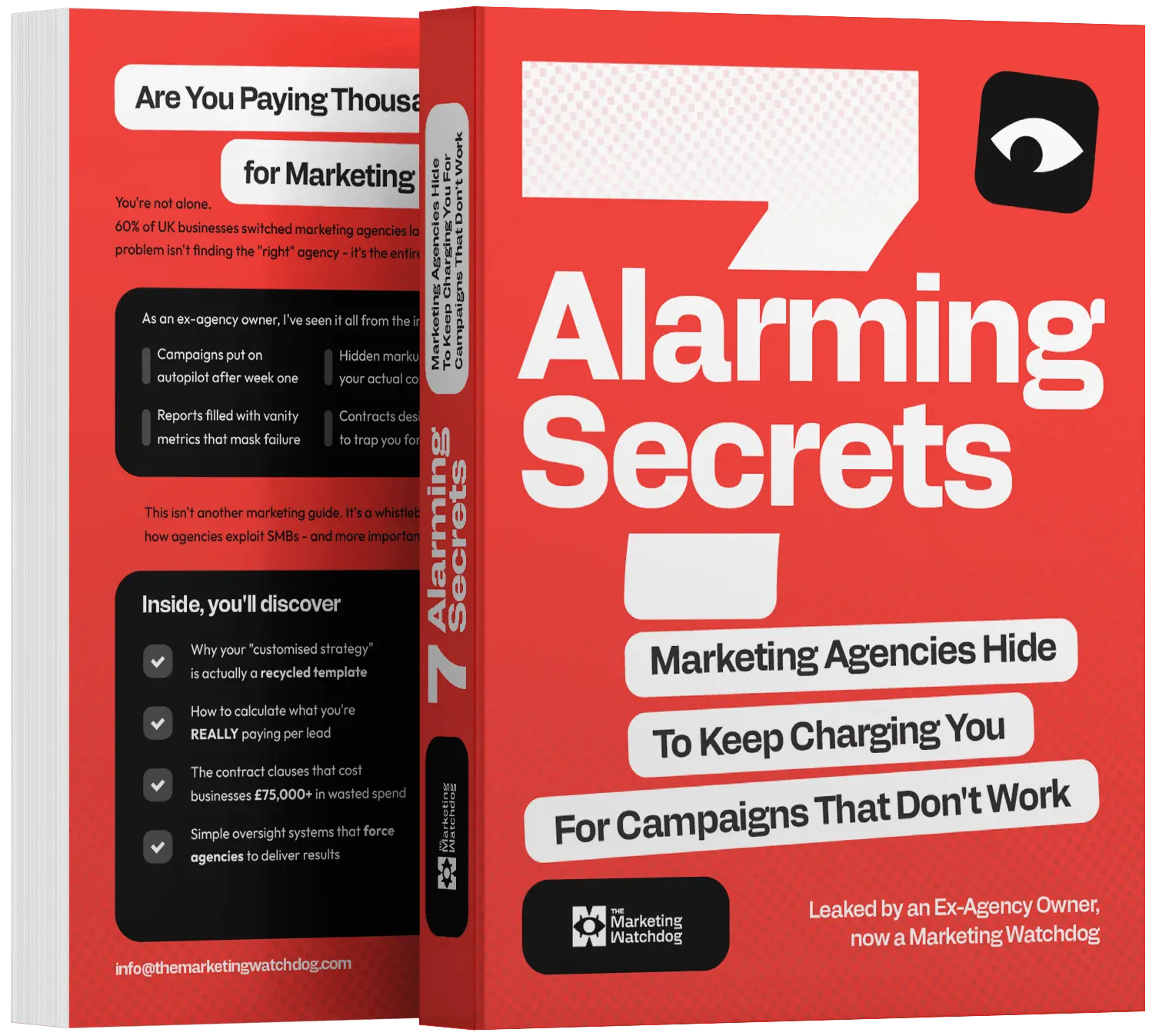
The Twenty-Five Thousand Pound Version
A glass manufacturer in London described his experience to me like this:
“I repeatedly explained that our industry had specific seasonal buying patterns and regulatory requirements. The agency kept running the same campaigns year-round and created content that made compliance claims we couldn’t legally make. When I pointed this out, they said they’d take it under advisement but never changed their approach. We wasted around £25,000 before I finally terminated the contract, which was my mistake, I admit.”
Read that last clause again. He blames himself for the delay, not the agency for the work.
That reaction is almost universal and it’s why these relationships run so long. The owner assumes the fault is his for not explaining well enough, so he explains again, and the meter keeps running. Twenty-five thousand pounds is roughly what that assumption costs at a mid-sized retainer before somebody finally says enough.
The compliance element is the part owners underestimate. A campaign that overstates a certification isn’t a wasted month. It’s a claim your business made in public, and the agency has no exposure to it whatsoever.
“We’ll Learn Your Industry” Is a Charge, Not a Promise
Plenty of agencies will offer to get up to speed. Some genuinely mean it, and a few succeed.
Two questions worth asking before you accept the offer.
First: who pays for the education? You’re at full rate from month one, funding a learning curve that a specialist had already climbed years ago. That’s not outrageous, but it should be named out loud rather than absorbed quietly.
Second: is it realistic? A generalist agency carries dozens of clients across unrelated sectors. Developing genuine depth in yours means the account manager reading your trade press in the evening, and nobody is doing that.
Where the offer is sincere, ask for it in the plan rather than the conversation. A named person, a stated number of hours, a date by which they’ll answer the questions they currently can’t. If that’s too much to write down, it was never going to happen.
And if you conclude you need someone else, look at the small specialists before the big generalists. A four-person firm that has worked in your sector for a decade will never win an industry award, which is worth remembering when the next pitch opens with a trophy slide.
Two Questions That Settle It
Before you decide anything, put these to your agency and listen to the shape of the answer rather than its length.
“Why was the January campaign the same as the September one, when I explained our buying cycle?” A good answer names a reason and a trade-off. A poor one explains their process.
“How did you check the compliance requirements before that content went out?” A good answer describes a step somebody took. A poor one is a promise about the future.
Send both in writing. Answers that arrive in writing tend to be more careful, and you’ll want the record either way. If the replies are vague, the wider pattern of templated strategy is usually already visible in the work, and the account manager will struggle with more basic questions than these.
Your Knowledge Is the Asset They’re Wasting
Here’s the part that should annoy you most, and it’s the reason I wrote this page.
Nobody understands your market better than you do. Not an agency juggling thirty accounts across a dozen sectors. You’ve spent years learning which objections come up, which competitors matter, which months are worth spending in. That knowledge is the single most valuable input any campaign could have.
And a certain kind of agency treats it as an interruption.
Client input arrives as a complication to a standardised workflow rather than the raw material it should be. You get nodded at. The plan proceeds. Twelve months later the campaign reflects the agency’s habits rather than your market, and everyone is puzzled about the results.
So the test isn’t really whether your agency knows your industry on day one. Almost none do. The test is whether they’re building on what you’ve told them, or working around it.
One of those is a supplier learning your business. The other is a supplier waiting for you to stop talking.
Find Out Which One You’ve Got
Free, written, and yours to keep either way.
What you receive:
- The six checks above, run against your actual campaigns and correspondence
- Spend plotted against your trading year, so you can see whether anyone planned around it
- Where sector knowledge you’ve already supplied has failed to reach the work
- A written specification your agency can work to, built from what you know about your market
That last point is usually the fix. Most agencies in this position aren’t incapable, they’re unbriefed, and a specification written by someone who understands both sides closes the gap faster than changing supplier does.
Stop Guessing. Start Knowing.
Get your free marketing assessment and find out what's really happening with your agency spend.
Get in Touch →