
Auto-Renewal Clauses and Other Contract Tricks to Avoid

Contract Tricks to Avoid
15th March, 9:47 AM.
You’re checking your business account when you notice the charge: £3,500 from your marketing agency. That’s odd. Your contract was supposed to end this month.
You dig out the agreement. Scroll to section 8. There it is:
“This Agreement shall automatically renew for successive twelve (12) month periods unless either party provides written notice of non-renewal at least sixty (60) days prior to the expiration of the then-current term.”
Your contract ended on the 1st. The cancellation window closed on January 1st. You missed it by 74 days.
You’re now committed to another full year of services you no longer want, from an agency that hasn’t delivered results, at a cost of £42,000 you hadn’t budgeted for.
This happens constantly. Not because business owners are careless, but because these clauses are designed to be missed.
Perhaps the most insidious contract technique is the “auto-renewal” or “evergreen” clause. These provisions automatically renew your contract (often for another full year) unless you provide written notice within a very specific window, typically 30-60 days before the term ends.
The effectiveness of this trap lies in its reliance on client oversight. Miss that narrow cancellation window by even a day, and you’re locked in for another billing period.
This article explains how auto-renewal clauses work, what other contract tricks agencies use, and exactly how to protect yourself from becoming another business owner who learned these lessons too late.
How Silent Renewal Works
In my experience, many agencies send minimal communications during the critical period before renewal. They don’t want to remind you that you have an option to leave.
The Typical Clause Structure
Auto-renewal clauses share common elements. An initial contract term (typically 6-12 months), automatic extension for a defined period (often matching the original term), a narrow notification window (usually 30-60 days before expiry), and specific requirements for valid notice (written, sometimes registered post).
The devil is in the details. Some contracts require notice “no fewer than 60 days prior.” Others specify “between 30 and 60 days before.” Miss the window in either direction and the renewal triggers.
Notification Requirements Buried in Terms
These clauses aren’t highlighted during sales conversations. They’re buried in standard terms, written in dense legal language that blends into surrounding paragraphs.
When you signed, you were focused on scope, deliverables, and costs. Termination provisions seemed like a formality. The agency didn’t walk you through section 8.
That was intentional.
The Timing Game
These clauses exploit the administrative burden faced by small business owners juggling dozens of responsibilities. It’s remarkably easy to miss a single contractual deadline, resulting in another year of unwanted fees.
Consider the maths. A 12-month contract with a 60-day notice window gives you exactly 10 months before you need to decide. But you’re probably not thinking about contract renewal at month 10. You’re running your business.
By month 11, when you might naturally consider renewal, the window has already closed.
What Happens When You Miss the Window
The moment the window closes, you’re committed. The agency has no obligation to remind you, warn you, or offer flexibility. The contract renewed. You owe the money.
Some agencies will negotiate when clients push back. Others will hold firmly to the contract terms, knowing most business owners can’t afford to fight.
One e-commerce business I consulted for had signed what they thought was a 3-month 50% discount “trial” that automatically rolled into a 12-month contract with a 90-day notice period. When they tried to leave after 4 months of poor performance, they discovered they were contractually obligated to pay for another 9 months regardless of results. The fact that this might not even be legal is often irrelevant. You know some business owners like you have no time for court hearings or paperwork.
Contract Provisions to Watch For
Auto-renewal isn’t the only trick. Here are other clauses that can trap you.
Price Escalation Clauses
Some contracts include provisions allowing agencies to increase fees without your explicit approval.
Annual increase provisions: “Fees may increase by up to X% annually” or “Fees will be adjusted in line with RPI/CPI.”
“Market rate” adjustments: Vaguer provisions allowing increases to “prevailing market rates” give agencies wide latitude.
What’s reasonable: Modest inflation-linked adjustments are standard. Uncapped increases or “market rate” provisions create unpredictable costs.
The Entry-Level Bait
Many agencies offer seemingly attractive “starter packages” or initial 3-month terms. What they don’t emphasise is that these agreements typically auto-convert to much longer commitments with significantly different termination terms.
The discounted trial feels low-risk. The 12-month commitment it converts into is anything but.
Scope Interpretation
Vague deliverable definitions create opportunities for “additional fees” surprises.
The pattern: Your contract says “social media management.” You assume that includes creating posts. The agency bills separately for “content creation.” You assumed wrong.
Statements of Work frequently contain vague descriptions like “SEO optimisation” or “social media management” with no specifics on deliverables, quantities, or frequencies. This deliberate vagueness allows agencies to classify routine requests as “out of scope” and charge additional fees.
Consider a scenario where a business owner receives a £650 invoice for “additional content creation” that they had assumed was included in their £3,000 monthly retainer. These surprise charges are part of a wider pattern of hidden fees and markups in agency pricing. The contract’s vague language about “managing content needs” versus “content creation” enables this exploitation.
Protection: Demand specificity. How many posts? How many keywords? What exactly is included?
Assignment Clauses
What happens if your agency is acquired, merges, or sells your contract to another company?
The issue: You chose this agency specifically. Their team, their approach, their reputation. Assignment clauses may allow them to transfer your contract to anyone, without your consent.
Staff change provisions: Some contracts include no protection if key personnel leave. The senior strategist who sold you can disappear, replaced by junior staff, with no breach of contract.
What to negotiate: Require written consent for any assignment. Include provisions allowing termination if key personnel change.
Jurisdiction and Arbitration
Where and how disputes are handled matters more than most clients realise.
Where disputes are handled: Some contracts specify jurisdiction in locations inconvenient for you. A UK business might find their dispute must be heard in Ireland or even offshore.
Arbitration clauses: These can prevent you from pursuing disputes in court, requiring private arbitration instead. Arbitration isn’t necessarily unfair, but it typically costs more and offers less transparency.
Cost implications: If pursuing a dispute costs more than the disputed amount, you effectively have no recourse.
Free Download: Report by an Ex-Agency Owner
7 Alarming secrets marketing agencies hope you never discover
Download Free Ebook →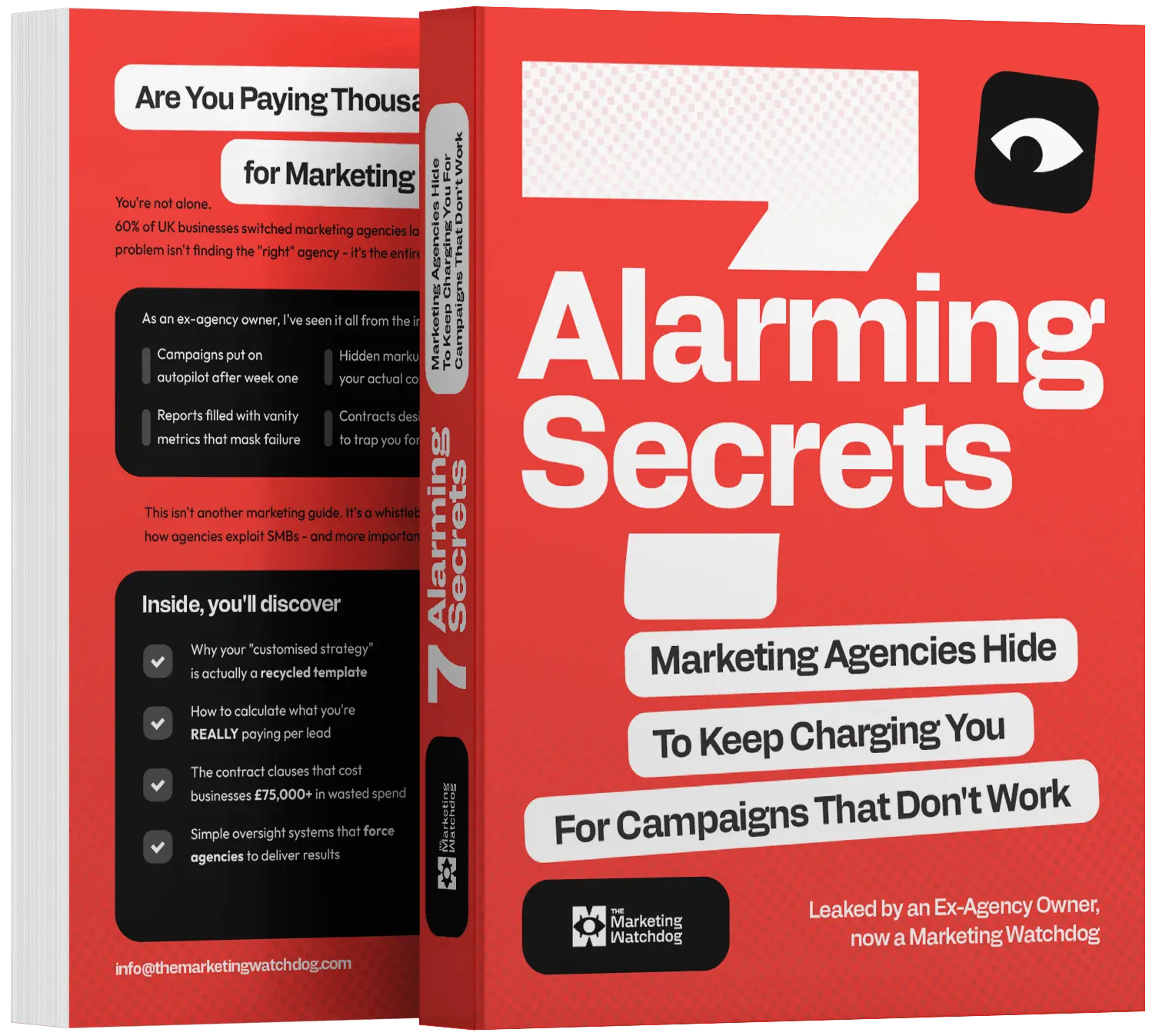
Not Sure What’s in Your Contract?
I can review your agency agreement and identify the clauses that could trap you.
Request Your Free Contract Review →
How to Protect Yourself
The best defence against contract tricks is awareness before you sign. But even with existing contracts, you have options.
Calendar the Critical Dates
Small tip: use scheduling options in Gmail and set some reminder emails to yourself to be sent in the morning, a day prior to an important date. It helps me a lot personally. Do it immediately, otherwise you’ll forget!
For every agency contract, calendar these dates immediately upon signing: contract start date, the date your cancellation window opens, the date your cancellation window closes (in bold, with multiple reminders), and the contract renewal date.
Set reminders for 90 days, 60 days, and 30 days before the cancellation window closes. Put them in your phone, your email calendar, and anywhere else you’ll actually see them.
Before Signing: The Questions to Ask
Before signing any agency contract, ask these direct questions:
“Is there any auto-renewal in this contract, and if so, how and when must we notify you to prevent it?”
“If we’re dissatisfied, exactly how much notice must we give to terminate?”
“Will we maintain administrative access to all platforms and data?”
Get answers in writing. If the agency is vague or evasive, that tells you something.
Demand Specific Contract Terms
Push for: No auto-renewal. If the agency wants to continue working with you, they can ask. Automatic extensions shouldn’t be the default.
Alternative: If they insist on auto-renewal, negotiate for agency notification requirements. They must notify you in writing 90 days before any auto-renewal takes effect.
Also negotiate: 30-day termination provisions rather than 60-90 days. Clear, specific deliverable definitions. Your ownership of all data and assets.
Inspect these specific clauses: limitation of liability, IP ownership, termination provisions, and scope definitions.
Written Confirmations
Any changes to contract terms, any verbal agreements, any promises made during negotiations, get them in writing.
If an account manager says “don’t worry, we never enforce that clause,” ask them to remove it from the contract or provide written confirmation. Verbal assurances are worthless when disputes arise.
For Existing Contracts
If you’re already in a contract with problematic terms, calendar the critical dates for cancellation windows immediately. Request admin access to all platforms. Export your data regularly in standard formats. Consider negotiating an early exit if performance is poor; sometimes, agencies will release you rather than risk reputational damage.
The Pattern Behind Contract Tricks
From my experience on both sides of the agency relationship, I’ve noticed a clear pattern: the more an agency relies on contractual handcuffs rather than performance to retain clients, the less confident they are in their ability to deliver results.
Auto-renewal clauses exist because agencies know some percentage of clients will miss deadlines. Price escalation clauses exist because agencies want to increase revenue without justifying the increase. Vague scope definitions exist because agencies want to charge extra for work clients assumed was included.
None of these clauses exist to benefit you. They exist to protect agency revenue regardless of performance. The government’s guidance on unfair contract terms may apply to provisions like auto-renewal, particularly where they catch businesses off guard.
The Urgency Illusion
Watch for pressure tactics during contract negotiations:
“We only have the capacity to take on two more clients this quarter.” “This special rate is only available if you sign this week.” “We need to launch before your competitor’s campaign goes live.”
These artificial pressure tactics create a false sense of urgency, encouraging you to sign quickly without thorough contract review. In roughly 95% of cases, there’s no genuine rush, just a desire to get your signature before you have time for proper due diligence.
If an agency won’t give you time to review the contract properly, that’s a red flag, not a reason to sign faster. Our full guide to marketing agency contract red flags covers everything you should check before putting pen to paper.
Don’t Let a Deadline Trap You
Contract tricks work because they’re designed to work. Auto-renewal clauses rely on you being too busy to track deadlines. Vague scope definitions rely on you not demanding specificity. Pressure tactics rely on you wanting to get started.
The defence is simple: slow down, read carefully, ask questions, get answers in writing, and calendar every important date the moment you sign.
If you’re already in a contract with problematic provisions, identify your next cancellation window and mark it now. Set multiple reminders. Don’t let another year slip by because of a date you forgot to track.
And if you’re evaluating new agencies, remember: fair contracts don’t need tricks. Agencies confident in their work don’t need auto-renewal traps to retain clients.
Know Your Contract Deadlines
Get Your Agency Agreement Reviewed
I’ll identify the auto-renewal clauses, notification requirements, and hidden provisions in your agency contract so you know exactly what you’re dealing with.
What You’ll Receive:
- Identification of all renewal and termination provisions
- Calendar of critical dates and deadlines
- Assessment of scope clarity and fee provisions
- Recommendations for negotiation or exit
Request Your Free Contract Review →
This post is part of a comprehensive series on holding your marketing agency accountable. Check for marketing agency contract red flags before you sign and find out how agency contracts protect them, not you.
Stop Guessing. Start Knowing.
Get your free marketing assessment and find out what's really happening with your agency spend.
Get in Touch →