Why Your “Custom Marketing Strategy” Looks Exactly Like Everyone Else’s

- Generic Agency Marketing Strategy: The Cookie-Cutter Problem
- How "Custom" Strategies Are Actually Made
- How to Spot a Cookie-Cutter Approach
- What Cookie-Cutter Strategy Costs Your Business
- The Hallmarks of Genuinely Personalised Strategy
- How to Get Strategy That's Actually Custom
- Stop Paying for Templates
- Get Strategy That's Actually Built for Your Business
Generic Agency Marketing Strategy: The Cookie-Cutter Problem
Your agency promised you a strategy built for your business. In the pitch meeting, they talked about understanding your challenges, getting under the skin of your market. It sounded like every recommendation would be shaped around what you specifically need.
A few weeks in, the strategy document lands in your inbox. Your logo on the cover, professional layout, the right fonts. But something about it doesn’t sit right.
Then you’re having coffee with another business owner who uses a completely different agency. They pull out their phone and show you their strategy document. The structure is almost identical.
Same recommended channels. Even some of the same language.
That nagging feeling was right.
I’ve been calling this “playbook mode” for years. Once you’re signed up and the initial excitement wears off, most agencies quietly shift from whatever bespoke approach they pitched to the same templates and tactics they run for every other client on their roster. Whether you’re a B2B software company in Manchester or a local trades firm in Kent doesn’t enter into it. The playbook is the playbook.
Let me be specific, because I don’t mean agencies using similar frameworks – that’s normal and often sensible. I mean the exact same document with your company name swapped in where the last client’s used to be.
And look – not every agency operates this way. But after twelve years of watching this pattern play out, I can tell you the ones who genuinely build from scratch are the exception. The rest are changing the logo on the cover page and calling it “customised” (which is exactly what they’re counting on you not checking).
Makes you wonder what you’re actually paying that retainer for, doesn’t it?
This article pulls apart how playbook mode works behind the scenes. I’ll show you how to spot it in your own agency’s output, and what a genuinely bespoke strategy looks like by comparison. Because the moment you can see the template underneath, the whole relationship changes.
How “Custom” Strategies Are Actually Made
The Agency Playbook Approach
I saw this repeatedly in my years running an agency: the fundamental tension between customisation (what clients need) and standardisation (what makes agencies profitable).
The economics are straightforward. Creating genuinely tailored strategies requires significant time investment: deep research into a client’s industry, thorough analysis of their competitors, detailed customer persona development, and crafting truly unique positioning. This work demands senior strategists with high salaries who could otherwise be pitching new business or managing more accounts.
So what happens instead?
One marketing director I spoke with admitted: “We have three standard campaign structures we apply to every client in this industry. We just change the logos, adjust the target audience settings, and update the ad copy. The entire setup takes us less than a day.”
Why This Happens
Several factors drive agencies toward standardisation:
Operational efficiency. Agencies can onboard clients faster, train staff more easily, and complete deliverables quicker using pre-defined templates and processes. As one agency owner I know put it, “Why reinvent the wheel when we already have a process that usually works?”
Scalability pressures. Most agencies face enormous pressure to grow. Using standardised playbooks allows them to handle more clients with fewer people. I’ve seen account managers juggling 50+ clients simultaneously, a workload that makes customisation physically impossible.
Budget constraints. Let’s be brutally honest about the maths. If your SMB is paying £1,500-3,500 monthly for marketing services, the agency can only profitably allocate about 5-8 hours of work to your account each month while covering salaries, software, office costs, and profit margins. That’s barely enough time to run standard reports and make basic adjustments to existing campaigns, let alone develop custom strategies.
Knowledge gaps. Many agencies claim to be “full-service” while lacking deep expertise across all industries and platforms. Rather than admit these limitations, they default to applying the tactics they know well across all clients, regardless of fit. I’ve watched agencies with expertise in Facebook ads recommend Facebook-first strategies to B2B industrial manufacturers whose customers aren’t even on the platform. This often ties into the agency bait-and-switch problem: senior strategists pitch the work, then hand execution to junior staff who default to the only playbook they know.
The Presentation vs. Reality Gap
The result? Your business, with its unique value proposition, specific industry challenges, and particular customer needs, gets forced into the agency’s pre-defined box rather than receiving the bespoke strategy you’re expecting (and paying for).
The strategy document looks impressive. The presentation is polished. But underneath the professional veneer is a template that’s been used dozens of times before with only superficial modifications.
How to Spot a Cookie-Cutter Approach
How can you tell if you’re getting a personalised approach or just a recycled playbook with your logo slapped on it? Watch for these red flags:
Surface-Level Discovery
The agency’s onboarding process involves minimal research about your business. Their intake forms contain generic questions applicable to any business. They don’t ask about profit margins, sales cycles, customer objections, or competitive differentiators. They’re rushing to “get started” without truly understanding what makes your business unique.
One client told me about his experience: “We spent 15 minutes on a call where they asked basic questions about our business. Two days later, they presented a ‘comprehensive strategy’ that was clearly a template – they’d even left another client’s name in one section!”
Identical Tactical Recommendations
The agency suggests the exact same marketing channels, campaign structures, or content strategies that you’ve seen them recommend to completely different businesses.
A clear example came from a manufacturing client who attended an agency’s webinar: “They presented the exact same social media strategy for a luxury spa that they had proposed for my industrial parts business.”
No Reference to Your Competitive Landscape
A genuinely custom strategy should address your specific competitors by name. It should identify gaps in their marketing that you can exploit, positioning opportunities they’ve missed, and threats they pose that need addressing. If your strategy document could apply to any business in any market, it’s not custom.
Ignored Customer Insights
You provided detailed information about your customers during onboarding: their pain points, buying behaviours, objections, and preferences. Yet the strategy makes no specific reference to any of it. The messaging recommendations are generic. The audience targeting is broad. Your industry expertise has been quietly sidelined.
Recommendations That Don’t Fit Your Reality
The strategy recommends tactics that don’t make sense for your situation: channels your customers don’t use, content formats that don’t suit your industry, or campaign timing that ignores your seasonal patterns. When you raise concerns, you’re told to “trust the process.”
For more on recognising when your agency doesn’t understand your industry, see our detailed guide.
Free Download: Report by an Ex-Agency Owner
7 Alarming secrets marketing agencies hope you never discover
Download Free Ebook →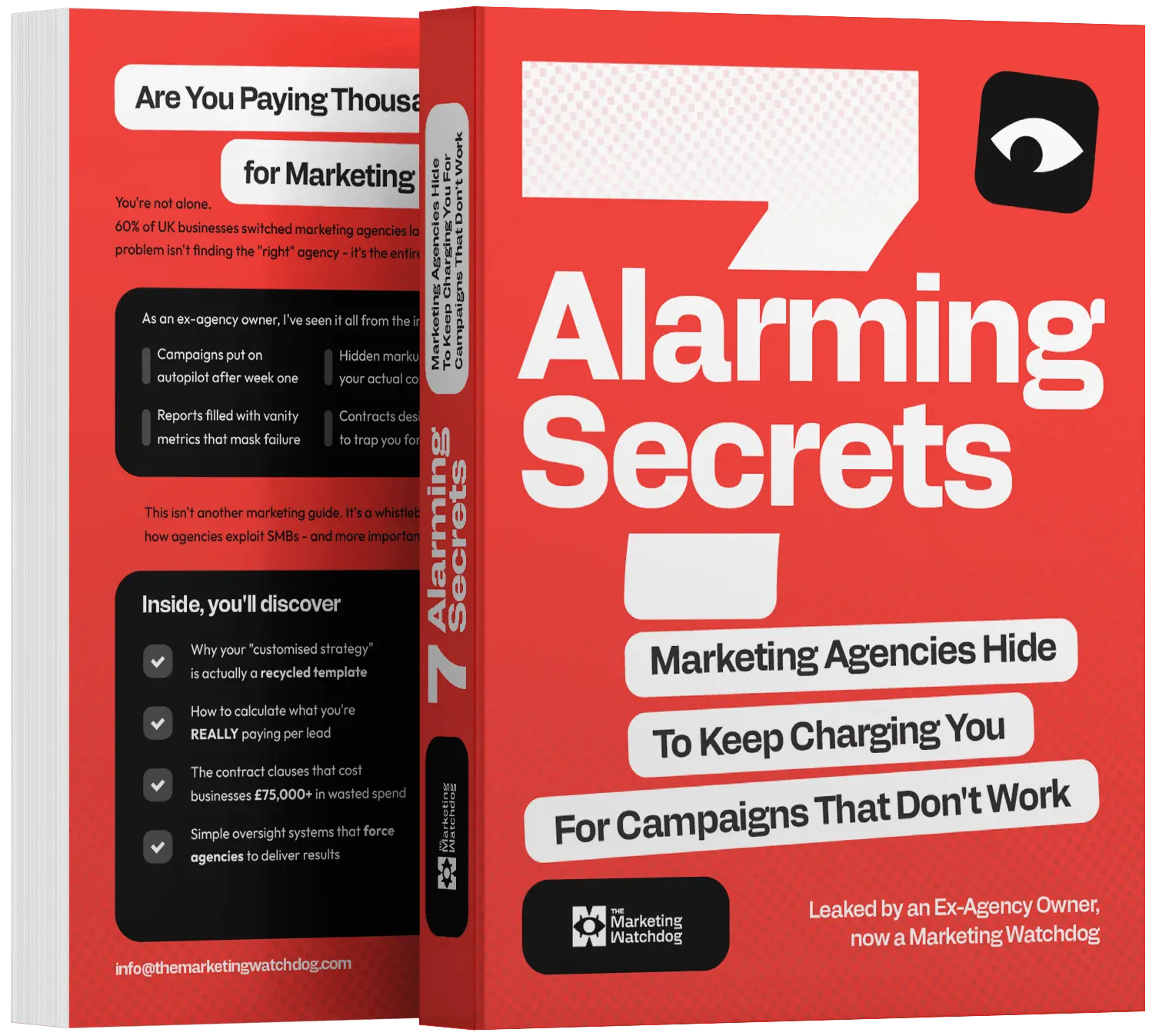
What Cookie-Cutter Strategy Costs Your Business
The consequences of generic strategy are predictable and damaging.
A Case Study in Wasted Investment
A small glass manufacturing business owner (London-based) shared this experience:
“I repeatedly explained that our industry had specific seasonal buying patterns and regulatory requirements. The agency kept running the same campaigns year-round and created content that made compliance claims we couldn’t legally make. When I pointed this out, they said they’d ‘take it under advisement’ but never changed their approach. We wasted around £25,000 before I finally terminated the contract, which was my mistake, I admit.”
This story illustrates exactly what happens when agencies force your square-peg business into their round-hole playbook.
The Real Costs
Campaigns that miss crucial industry nuances and regulations. Every industry has specific rules, whether formal regulations or informal norms. Generic strategies ignore these, creating content that’s inappropriate, ineffective, or in the worst cases, legally problematic.
Marketing messages that fail to address customer pain points effectively. Your customers have specific concerns, objections, and priorities. Generic messaging speaks to no one in particular, which means it doesn’t resonate with anyone specifically.
Wasted budget on channels your customers don’t use. If your agency recommends Instagram for your B2B industrial equipment business because “everyone should be on social media,” you’re throwing money away. Your customers aren’t scrolling Instagram looking for hydraulic systems.
Missed opportunities unique to your market. Every industry has specific opportunities that only become visible with deep market understanding: trade publications that influence buyers, events where decisions are made, partnerships that could open doors. Generic strategies miss all of this.
Increasingly strained client-agency relationships. When results don’t materialise, frustration builds. The agency blames market conditions or suggests more budget. You wonder why you’re paying for expertise that doesn’t seem to understand your business. The relationship deteriorates until someone finally pulls the plug, often after significant money has been wasted.
Rather than leveraging your invaluable industry knowledge, cookie-cutter agencies force your square-peg business into their round-hole playbook. The result is marketing that looks professional but fundamentally misses the mark. It’s not aligned with your business reality, customer needs, or market dynamics.
Suspect Your Strategy Isn’t Actually Custom?
I can review your marketing strategy and identify whether it’s genuinely tailored to your business or just a template with your logo.
Request Your Free Strategy Review →
The Hallmarks of Genuinely Personalised Strategy
Understanding what custom strategy actually looks like helps you evaluate what you’re getting.
Deep Industry Research
A genuinely personalised strategy demonstrates real understanding of your industry: its regulations, its buying cycles, its competitive dynamics, its customer behaviours. The agency should be able to discuss your industry with fluency, referencing specific publications, events, and trends that matter.
Competitor Analysis Specific to You
Your strategy should name your actual competitors and analyse their marketing specifically. What channels are they using? What messaging angles are they taking? Where are the gaps you can exploit? This isn’t about generic “competitive positioning” slides; it’s about specific, actionable intelligence about the businesses you’re actually competing against.
Customer Insight Integration
The insights you provided about your customers should be visibly integrated into the strategy. If you explained that your buyers are primarily CFOs concerned about compliance risk, the strategy should reflect that: channels where CFOs spend time, messaging that addresses compliance concerns, content formats that suit executive audiences.
Tactical Recommendations Matched to Your Business Model
The recommended tactics should make sense for how your business actually works. A high-ticket B2B service with a six-month sales cycle needs different tactics than an e-commerce business with impulse purchases. If your strategy doesn’t reflect your sales cycle, average deal value, and customer journey, it’s not custom.
Messaging That Reflects Your Positioning
Your brand has (or should have) a distinct position in the market. Custom strategy builds on this positioning with messaging that differentiates you specifically from your competitors, speaks directly to your ideal customers’ concerns, and reinforces what makes your business unique.
How to Get Strategy That’s Actually Custom
Questions to Ask Before Engagement
Before signing with any agency, ask:
- “Can you walk me through your strategy development process? How many hours do you typically spend on research for a new client?”
- “What specific questions will you need answered about my industry, competitors, and customers?”
- “Can I see a strategy document you’ve created for another client in a similar industry?” (If they’ve worked in your industry, the work should demonstrate deep understanding.)
- “Who specifically will be developing my strategy, and what is their background?”
The answers reveal whether you’re getting genuine customisation or template work.
Red Flags in Proposals
Watch out for proposals that promise strategy delivery within days of signing (real research takes time), that don’t ask detailed questions about your business before proposing, that use vague language like “industry best practices” without specifying what those are for your industry, or that can’t name specific competitors they’ll analyse. Ask them what do they know about your typical customers.
What to Demand During Strategy Development
Once engaged, insist on a proper discovery process that covers your industry’s specific dynamics, regulations, and norms. Demand that your competitors be researched by name. Require that customer insights you provide are visibly incorporated. Ask for the reasoning behind each tactical recommendation, specifically why it’s right for your business.
When to Walk Away
If the strategy you receive could apply to any business with minimal modification, if your industry expertise is being ignored, if recommendations don’t fit your reality and concerns are dismissed, it’s time to reconsider the relationship. Understanding this “one-size-fits-all” trap is crucial because truly effective marketing must be built on a strategy that’s uniquely aligned with your specific business objectives, industry context, and customer insights, not a recycled playbook designed for the agency’s convenience.
You deserve better than a template with your logo. Your business is unique. Your strategy should be too.
Stop Paying for Templates
The “custom strategy” pitch is one of the most common in the agency world. And for many agencies, it’s exactly that: a pitch, not a reality.
The signs are there if you know what to look for: rushed discovery, generic recommendations, ignored expertise, tactics that don’t fit your reality. These are just some of the warning signs your marketing agency is taking advantage of you. Once you see the pattern, you can’t unsee it.
Your marketing investment is too significant to waste on strategies designed for the agency’s convenience rather than your business’s success. You have unique challenges, unique customers, and unique opportunities. Your strategy should reflect that.
If you’re questioning whether your current strategy is truly custom, trust your instincts. Ask the hard questions. Demand the specificity you’re paying for. And if you’re not getting it, consider getting an independent marketing audit.
Your business deserves strategy built for it, not a recycled playbook with your name on it.
Get Strategy That’s Actually Built for Your Business
Request Your Free Strategy Assessment
I’ll review your current marketing strategy and identify whether it’s genuinely tailored to your business or a template approach that’s costing you results.
What You’ll Receive:
- Assessment of strategy customisation level
- Identification of cookie-cutter elements
- Gap analysis against your business needs
- Recommendations for improvement
Request Your Free Assessment →
This post is part of a comprehensive series on holding your marketing agency accountable. Discover the signs your agency doesn’t understand your industry, learn why industry expertise matters more than marketing awards, and understand the bait-and-switch behind senior pitches and junior execution.
Stop Guessing. Start Knowing.
Get your free marketing assessment and find out what's really happening with your agency spend.
Get in Touch →