£75,000 Lost in 18 Months. And the Reports Looked Fantastic the Entire Time.

£75,000 Lost in 18 Months. And the Marketing Agency Reports Looked Fantastic the Entire Time.
I consulted for a home services company that had been paying their agency circa £8,000 a month. Management fees and media creation, all bundled together in one tidy invoice.
For approximately 18 months, this company received beautiful monthly reports. Click-through rates trending upward. Quality scores improving. Engagement metrics climbing nicely. The kind of numbers that make you think everything’s working exactly as it should.
It wasn’t.
By the time I got involved, the Reporting Black Box had cost this company an estimated £75,000 in wasted spend and lost revenue. Eighteen months. That’s not a slow drip over a decade – unlike the £170,000 case I wrote about previously. This was a firehose of cash, spraying in the wrong direction, whilst every report said otherwise.
And here’s what makes this one stick with me: they had no reason to doubt anything. The graphs went up. Every single month.
The Business Behind the Numbers
I’m keeping the specifics anonymised (for obvious reasons), but here’s what you need to know about this company.
They were a home services business. The kind of company that relies on a steady stream of local enquiries to keep the vans moving and the teams busy. Not a startup experimenting with their first ad campaign. An established operation with real turnover, real staff, and real growth goals.
Their marketing budget reflected that ambition. Circa £8,000 per month going to their agency covered management fees and media creation across multiple channels – PPC, social media advertising, the lot. That’s not a token investment. That’s serious money for a business of this size, and they expected serious results in return.
So why did they hire an agency in the first place? Same reason most business owners do. They’d reached a point where handling marketing internally wasn’t cutting it anymore. They needed someone who could run campaigns properly, optimise them over time, and actually grow the number of qualified leads coming through the door. They wanted to scale, and they were willing to pay for it.
The agency that won the pitch made all the right noises. But I’ll get to that.
Thing is, this company wasn’t naive. They asked questions. They reviewed reports. They attended the monthly catch-up calls. And that’s precisely what makes this case study worth reading – because doing all of those things still wasn’t enough to spot what was going wrong under the surface.
How the Relationship Started
The pitch was convincing. It always is.
You know how it goes. You sit in a room (or more likely a Zoom call these days) with someone articulate and confident who walks you through a strategy that sounds bespoke to your business. They reference your competitors. They mention your service areas. They talk about the specific channels that make sense for your industry. It all feels very tailored.
The first few weeks matched the pitch, too. Activity was visible – campaigns getting set up, creatives being designed, landing pages going live. There was a genuine sense of momentum. Emails back and forth, regular updates, the occasional phone call to discuss targeting or messaging. That initial honeymoon period before campaigns go on autopilot where everything looks like it’s heading in the right direction.
And this is where the trust builds. Because when you’re a business owner watching an agency deliver what they promised in month one and month two, you relax. You stop scrutinising every detail. You start assuming the people you’re paying £8,000 a month know what they’re doing.
That assumption costs more than most people realise.
The monthly reports started arriving like clockwork. Beautifully formatted. Click-through rates, quality scores, engagement metrics – all showing steady improvements. If you’re not a digital marketing specialist (and most business owners aren’t, nor should they need to be), these reports looked like proof that the investment was paying off.
But here’s what those reports didn’t show: whether any of it was actually generating business. The reports talked about clicks. They talked about impressions. They talked about engagement. What they never talked about was leads that turned into customers. Or revenue. Or anything you could actually take to the bank.
I know what you’re thinking – surely the business owner noticed the phone wasn’t ringing more? And to a degree, yes. But when your agency is telling you that these things take time, that the metrics are trending in the right direction, that you need to “trust the process”… you give them another month. Then another. That’s the vanity metrics trap in action.
What I Found When I Finally Got Access
When I finally gained direct platform access – and I say “finally” because getting that access was a minor miracle in itself – what I found was properly damaging.
Let me walk you through it, because this is the bit that matters.
40% of the PPC budget was going to branded search terms. People already searching for the company by name. Now, bidding on your own brand isn’t automatically a bad idea – there are legitimate reasons to do it. But the problem here was that the keyword pool also contained competitor brand names, which resulted in massive overspending. They were paying through the nose to show up for searches they’d already won organically, whilst simultaneously burning money bidding on brands they’d never convert.
Their landing pages hadn’t been updated or tested in over a year. Eighteen months of campaigns running, £8,000 a month flowing out, and not a single A/B test on the pages where the traffic was actually landing. The same pages from month one were sitting there in month eighteen, unchanged. That’s not optimisation. That’s not even maintenance.
The social media campaign targeting included geographic areas they didn’t even service. I need you to sit with that one for a second. They were paying for ads being shown to people in areas where the company physically could not do the work. Money, literally thrown to the wind.
Several underperforming ad sets hadn’t been touched in months despite having zero contribution to the conversion funnel. Not low contribution. Zero. These ad sets were doing nothing except spending money. And nobody at the agency had bothered to pause them, rework them, or even look at them.
And remember – the reports showed improvements the entire time. Click-through rates up. Quality scores improving. Engagement climbing.
Impressive graphs. Meaningless numbers.
Can you imagine what I felt when I sorted it out and knew that I was losing to such competition in this market? I ran an agency. I’ve been on the other side of this. I lost pitches to companies doing exactly this kind of work – or rather, this kind of non-work. And clients never knew the difference until it was too late.
Free Download: Report by an Ex-Agency Owner
7 Alarming secrets marketing agencies hope you never discover
Download Free Ebook →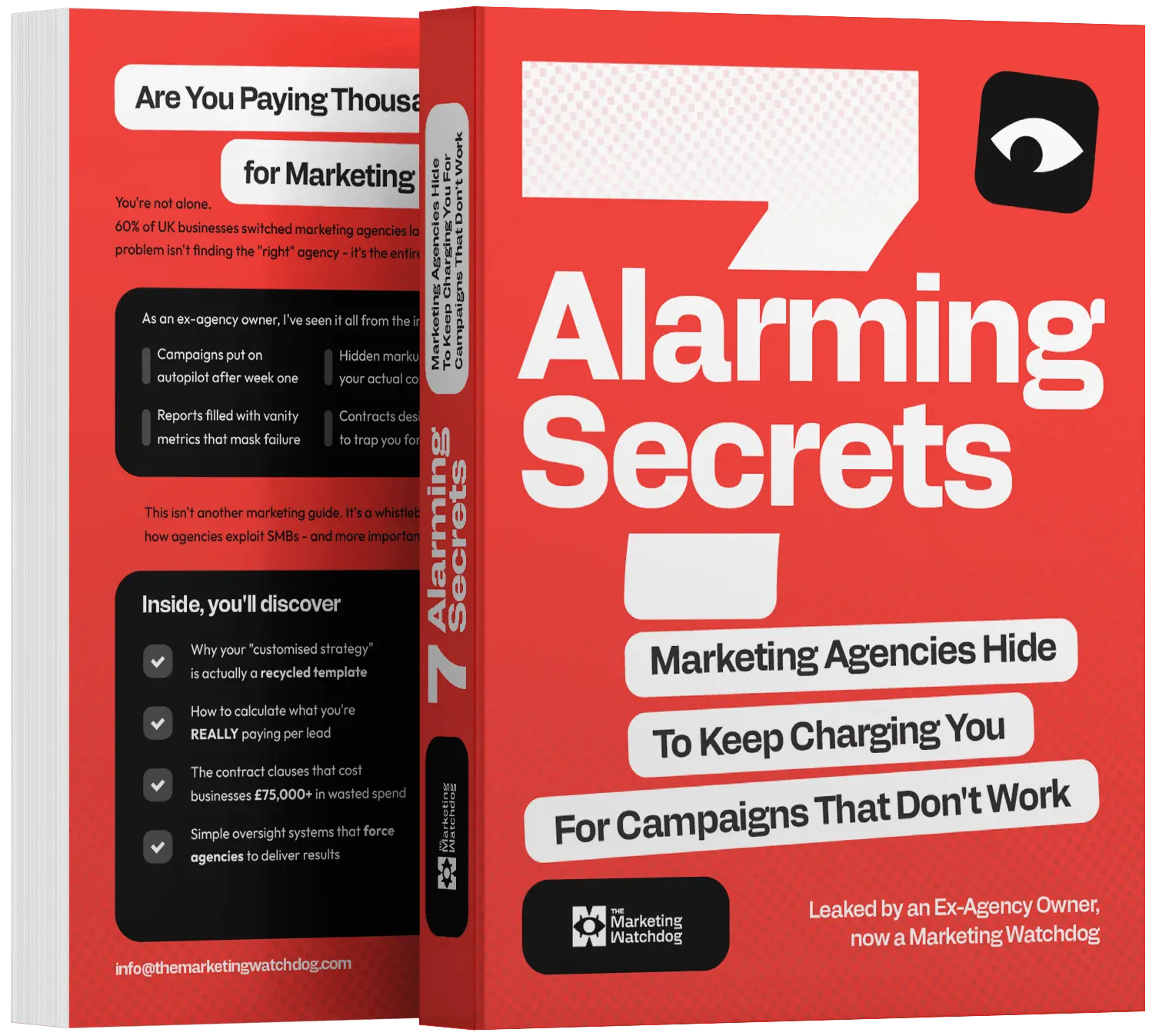
Think your agency might be doing the same thing? Request a free agency review and I’ll tell you exactly what’s happening inside your ad accounts. No obligation, no sales pitch – just the truth about where your money is going.
The Real Cost: More Than £75,000
Let me break down the maths, because the headline figure barely scratches the surface.
Circa £8,000 per month for approximately 18 months. That’s roughly £144,000 in total spend. Not all of that was wasted – some of the activity did generate results, particularly in the early months when the campaigns still had some momentum from the initial setup.
But the estimated damage? £75,000 in wasted spend and lost revenue over the engagement. That’s more than half of everything they invested, gone. Burned on branded terms they didn’t need to bid on, geographic areas they couldn’t serve, and ad sets that were generating absolutely nothing.
And that figure doesn’t even capture the full picture. It doesn’t account for the opportunity cost – the leads they should have been getting but weren’t. The growth that should have happened but didn’t. Eighteen months of potential business that went to their competitors instead.
Here’s the part that really stings though. After implementing basic fixes – sorting out the keyword strategy, updating the landing pages, fixing the geographic targeting, pausing the dead ad sets – their lead volume increased by 62% (as far as I can recall) while reducing their media spend by 30%. All within six weeks.
Six weeks. That’s how long it took to undo 18 months of neglect. Which tells you something about how straightforward the fixes actually were. This wasn’t a case of needing some revolutionary new approach. It was basic campaign hygiene that any competent agency should have been doing from month one.
What This Case Teaches
Look, I don’t share these case studies to scare anyone. I share them because the patterns repeat themselves, and knowing what to watch for puts you in a fundamentally stronger position.
So what should this company have done differently? And what can you learn from their experience?
Demand platform access from day one. If your agency won’t give you direct admin access to the platforms where your campaigns run, that’s a red flag. Full stop. Getting access to this company’s accounts was “a minor miracle” – it shouldn’t have been. It’s your money. It’s your data. You have every right to see it. Our marketing audit guide walks you through exactly how to demand it.
Don’t accept reports that only show activity metrics. Click-through rates and quality scores are nice to know, but they’re not business outcomes. Ask for lead numbers. Ask for cost per acquisition. Ask how many of those clicks turned into actual customers. If your agency can’t connect their reports to your bottom line, something is wrong.
Get an independent review if anything feels off. You don’t need to understand PPC or social media targeting at an expert level. But if your sales seem to plateau each month whilst the reports keep telling you everything’s improving, trust that instinct. Something doesn’t add up.
Check geographic targeting yourself. It takes five minutes. Log into the ad platform (which you should have access to), look at where your ads are being shown, and compare it to where you actually operate. If there’s a mismatch, you’ve found money walking out the door.
Eighteen Months of Paying for Nothing to Change
This company’s story isn’t unusual. That’s the uncomfortable truth. I’ve seen the pattern repeated across industries and business sizes. The intentional opacity created by agencies doesn’t just hide poor performance – it actively prevents improvement. You can’t fix what you can’t see.
The £75,000 this home services company lost isn’t coming back. But the six weeks it took to fix things? That tells you everything about how avoidable this was.
Something to think about next time you open that monthly report and all the graphs point upward.
Want to know if your agency is managing your campaigns properly – or just managing the reports? Book a free, independent agency review and get the truth. I’ll look at exactly what’s happening inside your accounts, the same way I did for this home services company. No contracts, no lock-in. Just clarity.
This case study is based on a real consulting engagement. Business details have been anonymised to protect the client’s identity. All figures, statistics, and findings are drawn directly from the actual audit.
Related reading:
Stop Guessing. Start Knowing.
Get your free marketing assessment and find out what's really happening with your agency spend.
Get in Touch →