
Why Your Marketing Reports Look Great But Sales Are Flat

- Marketing Reports Look Great But Sales Are Flat? Here's Why
- Understanding the Gap Between Reports and Reality
- The Art of Looking Good on Paper
- The Specific Metrics Masking Your Problem
- Connecting Marketing Activity to Business Results
- Red Flags That Demand Action
- Stop Accepting Reports That Don't Match Reality
- Get Clarity on Your Marketing Performance
Marketing Reports Look Great But Sales Are Flat? Here’s Why
It’s the first Monday of the month. The agency report lands in your inbox.
You open it. Charts trending upward, green arrows everywhere. Website traffic is up 23%, impressions have jumped 40%, and engagement is apparently “outperforming industry benchmarks”. Your account manager sounds pleased on the call. Everything, according to them, is heading in the right direction.
Then you check your actual sales figures.
Flat. Maybe even down.
The leads feel about the same as last month, maybe worse. Your phone isn’t ringing any more than it was. Nothing in the pipeline has shifted.
So what exactly are you paying for? Because according to every metric in that report, your marketing is doing brilliantly.
I hear this from business owners across the UK, month after month. The same frustration, the same question: “If all these metrics are improving, why isn’t my business growing accordingly?”
Here’s the thing. You’re not imagining it. That gap between what the report shows and what your bank account says is real, and it’s one of the most common problems I come across. After twelve years in this industry, I can tell you it’s rarely accidental.
Actually, let me be more direct. In a lot of cases, it’s deliberate. Agencies know exactly how to build a report that looks impressive. That’s a completely different skill from building campaigns that generate actual business (and I’ve seen this play out dozens of times). The report isn’t failing. It’s doing precisely what it was designed to do: keep you paying whilst your sales plateau month after month.
So this article breaks down why this disconnect happens and how agencies construct reports that mask poor performance. More importantly, I’ll show you what to check – and what questions to ask – the next time that monthly PDF arrives in your inbox.
Because once you see how this works, you can’t un-see it.
Understanding the Gap Between Reports and Reality
The disconnect between reports and results comes down to a fundamental difference between two types of metrics.
Activity Metrics vs. Outcome Metrics
Activity metrics measure what’s happening: impressions served, clicks generated, pages viewed, posts published, emails sent. They show that work is being done and that something is occurring.
Outcome metrics measure what’s achieved: leads generated, sales closed, revenue attributed, customers acquired. They show whether that activity actually produced business value.
The problem? Agencies love reporting activity metrics because they’re easy to influence and almost always trend positively if you’re spending money. But activity without outcome is just noise.
The Reporting Game Agencies Play
When campaigns fail to generate qualified leads, sales, or a positive ROI, agencies shift focus to easily achievable metrics like impressions or follower growth to create an illusion of success. This is a deliberate strategy, not an oversight.
As I’ve explored in my breakdown of vanity metrics vs. business metrics, vanity metrics are characterised by being superficially impressive, easy to measure and manipulate, lacking substance and context, and having no direct link to business objectives.
When your reports are full of these metrics while carefully avoiding discussion of sales, revenue, or ROI, the agency is playing a game designed to justify their retainer while obscuring their actual impact.
How to Spot the Disconnect in Your Own Reports
Pull out your last three monthly reports and ask these questions:
- How many times is “revenue” or “sales” mentioned compared to “impressions” or “reach”?
- Is there a clear line drawn from marketing activities to business outcomes?
- Are the metrics being celebrated actually metrics you’d choose to optimise for?
- When you compare report dates to your actual sales data, do the trends match?
If your reports celebrate traffic while ignoring conversions, or highlight reach while avoiding ROI, you’re experiencing the disconnect firsthand.
The Art of Looking Good on Paper
Understanding how agencies create impressive-looking reports helps you see through the smokescreen. Here are the common tactics.
Selecting Metrics That Show Progress
Every marketing campaign produces dozens of measurable data points. Agencies choose which ones to highlight. If cost per acquisition increased (bad), but cost per click decreased (neutral), guess which one makes the report? If conversion rate dropped but traffic increased, the report will celebrate traffic growth.
This selective reporting isn’t technically lying. It’s just not telling the whole truth. The metrics chosen for prominence are the ones that make the agency look good, not necessarily the ones that matter to your business.
Avoiding Metrics That Matter
Notice what’s consistently absent from your reports. Metrics like true cost per acquisition (including all fees), marketing-attributed revenue, return on ad spend, and lead-to-sale conversion rates require connecting marketing to actual business outcomes. That connection often reveals uncomfortable truths.
When sales conversions drop, suddenly the report highlights engagement metrics. When engagement falls, they emphasise reach. When reach declines, they tout “brand awareness.” This continuous shifting of the goalposts makes it nearly impossible to hold agencies accountable to consistent performance standards.
Creative Interpretation of Data
“Up 150% month-over-month!” sounds impressive until you realise you went from 2 leads to 5. Percentage increases on small numbers can be technically accurate while being practically meaningless.
Similarly, “outperforming industry benchmarks” often references benchmarks the agency selects, not necessarily relevant comparisons for your specific business or goals.
Year-Over-Year Cherry-Picking
“Traffic is up 45% compared to the same period last year!” This sounds great until you remember that last year this period included a major holiday, or that you’ve tripled your ad spend since then, or that the previous year was unusually bad for unrelated reasons.
Selective comparison periods let agencies craft whatever narrative they want.
Benchmarking Against Low Bars
Setting initial targets low enough that they’re easily exceeded is a classic tactic. If the agency defines success, they’ll define it in ways they can achieve. That’s why you need to establish your own success criteria based on business outcomes, not activity levels.
The Specific Metrics Masking Your Problem
Let’s examine the most common disconnects between reported metrics and business reality.
Traffic Up, Conversions Flat
Your agency reports website traffic increased by 30% this month. Fantastic news, right?
But if your conversion rate dropped from 2.5% to 1.5% during the same period, you might actually have fewer leads than before. Research shows agencies sometimes drive unqualified traffic to websites through clickbait tactics or irrelevant keywords merely to boost this number.
The question to ask: “How many of those visitors took a meaningful action?”
Impressions Increasing, Leads Not
“Your ad was seen by 50,000 people this month!” Agencies love to report impressions because they’re easy to increase by simply spending more or broadening targeting.
However, impressions and reach merely indicate potential audience size, not whether people took action or if exposure led to tangible results like website visits or sales. One case study showed an agency bragging about a low cost per view (CPV) of £0.0037, initially exciting the client, but the campaign ultimately failed to generate the necessary revenue.
The question to ask: “How many of those impressions converted to enquiries?”
Engagement High, Sales Absent
Comments, likes, shares, and saves look great in a social media report. But one study I analysed highlighted a particularly telling case: a business achieved actual sales from Instagram content with just ~30 views, while another client’s “viral” content generating hundreds of thousands of views resulted in zero sales. These high numbers “didn’t make them a dime.”
Engagement that doesn’t convert to leads or sales is entertainment, not marketing.
The question to ask: “How does this engagement translate to revenue?”
Followers Growing, Revenue Static
A large follower count might look impressive, but it’s meaningless if your audience isn’t interacting or converting. High numbers of likes or followers can be easily inflated through methods like purchasing followers or running contests targeting non-customers.
If your follower count doubled but your sales from social media stayed flat, those new followers aren’t potential customers.
The question to ask: “How many of these followers have become customers?”
Free Download: Report by an Ex-Agency Owner
7 Alarming secrets marketing agencies hope you never discover
Download Free Ebook →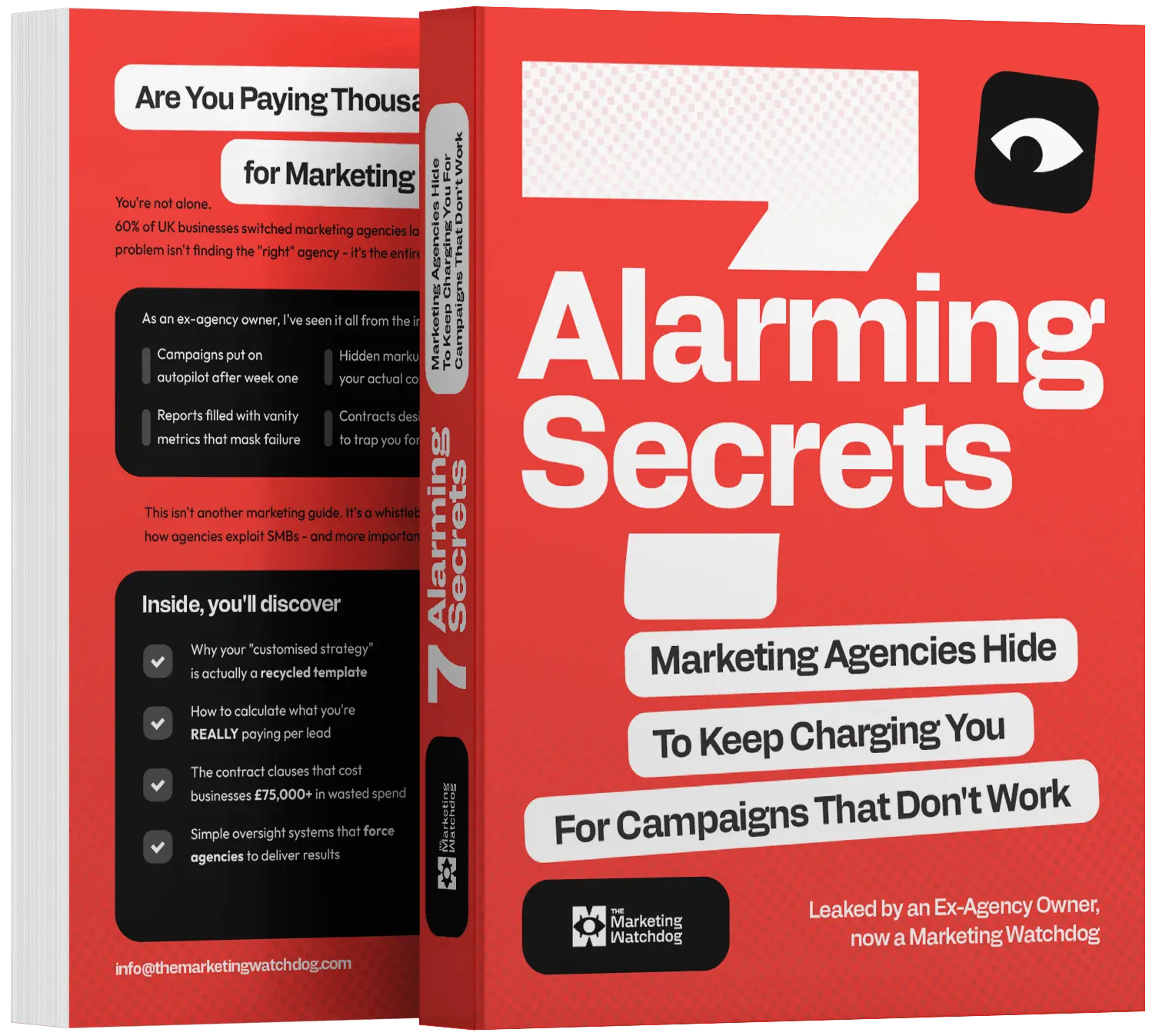
Experiencing the Disconnect?
I can analyse your agency reports alongside your actual business data to identify where the gaps are and what they’re costing you.
Request Your Free Report Analysis →
Connecting Marketing Activity to Business Results
Bridging the gap between reports and reality requires demanding better measurement and accountability.
The Attribution Question
Many agencies resist integrating their marketing platforms with your CRM or sales systems. Without this connectivity, it’s impossible to follow a lead from initial marketing touch through to final sale. This broken attribution chain makes calculating an accurate ROI nearly impossible.
Many of my clients discovered their agency had been claiming credit for all website-generated leads, even though detailed analysis showed most came from direct searches for the company name, effectively existing customers or referrals that the agency had no part in generating.
Demand proper attribution tracking. Google Ads conversion tracking is a baseline requirement for any paid search campaign. If your agency can’t show which of their activities generated which customers, they can’t prove their value.
Demand Revenue-Connected Metrics
Businesses should insist that reporting prioritises metrics directly connected to the bottom line, with vanity metrics used only for secondary context.
The metrics that actually matter include return on ad spend (ROAS), cost per acquisition (CPA) including all fees, marketing-attributed revenue, and lead-to-customer conversion rate. See our guide to measuring digital marketing ROI for the full breakdown. If these aren’t front and centre in your reports, your agency may be hiding the numbers that matter.
What to Ask in Every Report Meeting
Turn every report presentation into an accountability conversation with these questions:
- “How does this metric impact our bottom line?”
- “What’s our cost per acquisition this month, including your fees?”
- “How many of these leads became actual customers?”
- “What’s our return on ad spend across all channels?”
- “Which specific marketing activities generated revenue this month?”
When presented with impressive-looking metrics, always ask: “How does this impact my bottom line?” If the connection is tenuous or the agency struggles to explain it clearly, be suspicious.
Creating Accountability
Establish clear business objectives from day one. Don’t let your agency define success. You tell them what actual business outcomes you need. According to research, these should be specific, measurable, and directly tied to revenue or profitability.
For example: generate X qualified leads per month at a cost of £Y per lead, achieve a ROAS of 3:1, or increase online sales by Z% within 3 months. Yes, it is that simple. Ignore the friction; just demand this to be the primary objective.
Red Flags That Demand Action
Some patterns indicate the disconnect has become serious enough to require intervention.
Six or More Months of “Good Reports” with Flat Sales
If your reports have been positive for half a year while your business results haven’t improved, something is fundamentally wrong. Either the metrics being reported don’t connect to business outcomes, or the agency is obscuring poor performance. Either way, the relationship isn’t delivering value.
Agency Resistance to Revenue Discussion
When you ask about ROI and the agency pivots to engagement metrics, they’re deflecting. One SMB owner reported feeling “gaslit” when agencies dismissed concerns about poor ROAS by emphasising engagement figures. This disconnect often stems from a fundamental misalignment in how “success” is defined by the agency versus the client.
Inability to Show Marketing-to-Sales Connection
If your agency cannot demonstrate which of their activities resulted in actual customers, they cannot prove they’re generating return on your investment. “We don’t have visibility into your sales data” isn’t an excuse. Proper tracking and attribution is part of professional marketing practice.
Time for Independent Assessment
If you recognise these patterns, consider getting an independent review of your marketing performance. An objective third party can analyse both agency reports and your actual business data to identify where the disconnect is occurring and what it’s costing you.
Sometimes the problem is fixable with better tracking and accountability. Sometimes the relationship has run its course. Either way, you need clarity.
Stop Accepting Reports That Don’t Match Reality
The next time you receive a report filled with impressive-looking numbers, ask yourself one simple question: has my business actually grown?
If the answer is no, those numbers don’t matter. Charts going up and to the right are meaningless if your revenue line is flat.
As one business owner aptly put it: “I need to know that my marketing budget is being spent wisely and that the agencies I work with are actually helping my business grow. I want clear results and honest communication, not just empty promises.”
You deserve reports that tell you whether your investment is working. Not reports designed to make your agency look busy while your business stays stuck.
Demand the connection between activity and outcome. Your business depends on it.
Get Clarity on Your Marketing Performance
Request Your Free Report vs. Reality Analysis
I’ll compare your agency’s reports to your actual business results and identify where the disconnect is occurring.
What You’ll Receive:
- Analysis of report metrics vs. business outcomes
- Identification of meaningful vs. vanity reporting
- Attribution gap assessment
- Recommendations for accountability
This post is part of a comprehensive series on marketing agency accountability. Learn more about vanity metrics vs. business metrics, discover how to read your marketing reports properly, and understand the excuses agencies use to avoid accountability.
Stop Guessing. Start Knowing.
Get your free marketing assessment and find out what's really happening with your agency spend.
Get in Touch →