
7 Warning Signs Your Marketing Agency Is Taking Advantage of You

- 7 Warning Signs Your Marketing Agency Is Taking Advantage of You
- Warning Sign #1: Set-It-and-Forget-It Campaigns
- Warning Sign #2: Hidden Markups and Fee Opacity
- Warning Sign #3: Vanity Metric Overload
- Warning Sign #4: Cookie-Cutter Strategy
- Warning Sign #5: Junior Staff Execution
- Warning Sign #6: Data Access Restrictions
- Warning Sign #7: Contract Handcuffs
- Taking Action on Warning Signs
- Trust Your Instincts
- Get an Independent Assessment
7 Warning Signs Your Marketing Agency Is Taking Advantage of You
Looking back, every business owner who’s been burned by a marketing agency says the same thing: “The signs were there. I just didn’t see them.”
The reports that seemed impressive but never translated to sales. The senior strategist who disappeared after the contract was signed. The “just trust us” responses to simple questions about where the money was going. The contract terms that made leaving feel impossible.
These aren’t random problems. They’re patterns. And once you know what to look for, they’re remarkably consistent.
I’ve spent years on both sides of the agency relationship. I’ve seen how the best agencies operate, and I’ve seen how the worst ones exploit their clients’ trust. The difference often isn’t in what agencies say, it’s in what they don’t want you to notice.
The warning signs I’m about to share come from analysing dozens of agency relationships and hearing from hundreds of business owners who felt something was wrong but couldn’t articulate exactly what. With over 5.5 million small businesses in the UK, the scale of this problem is enormous. These are the red flags that should set your alarm bells ringing.
If you recognise even two or three of these in your current agency relationship, it’s time for a serious conversation. If you recognise most of them, it’s time for a change.
Warning Sign #1: Set-It-and-Forget-It Campaigns
What it looks like: Your campaigns haven’t been substantially optimised in months. The same ad creative, keywords, and targeting have remained static despite changing market conditions.
Your Google Ads account shows the same campaigns that were set up six months ago. The Facebook ads running today are the same ones that launched at the start of the engagement. When you ask about optimisation, you get vague assurances rather than specific details about what’s been tested, changed, or improved.
Why it matters: Effective marketing requires constant attention. Markets shift, competitors adjust, seasonal patterns emerge, and audience behaviour evolves. Campaigns that worked three months ago may be bleeding money today.
Without continuous optimisation, testing new ad variations, refining keyword targeting, adjusting bids based on performance, and improving landing page experiences, campaigns inevitably become stale and decline in effectiveness. Your advertising budget gets poured into clicks that don’t convert, ads shown to irrelevant audiences, and inefficient bidding strategies that inflate costs.
How to verify: Request change logs from your advertising platforms. Ask specifically: “What changes were made to our campaigns last month?” If the answer is vague, or if the account shows minimal activity beyond the initial setup, you have a problem.
Learn more: How agencies quietly stop managing your campaigns | Google Ads audit checklist
Warning Sign #2: Hidden Markups and Fee Opacity
What it looks like: Your agency refuses to provide original vendor invoices or platform spend screenshots. When asked about costs, they use vague terms like “industry standard practices” rather than transparent breakdowns.
You know how much you’re paying the agency each month, but you don’t know exactly where that money goes. Requests for platform spend verification are deflected. Questions about what portion of your budget actually reaches the advertising platforms are answered with generalities.
Why it matters: Some agencies mark up media costs by 20-50% or more without disclosure. A client paying £5,000 monthly might assume most of that reaches the advertising platforms, when in reality £2,000 or more goes to undisclosed agency margins.
This isn’t just about fairness. It fundamentally distorts your understanding of campaign economics. You can’t make good decisions about budget allocation when you don’t know your true costs.
How to verify: Ask a direct question: “Of our £X monthly spend, exactly how much reaches the advertising platforms, and how much represents your fees?” Request screenshot verification from platform dashboards. If they resist, that resistance tells you something.
Learn more: The fees your agency doesn’t mention upfront | What your agency actually takes from your ad spend
Warning Sign #3: Vanity Metric Overload
What it looks like: Reports are filled with impressive-looking numbers (impressions, reach, engagement) but conspicuously lack direct business outcomes like qualified leads, sales, and ROI.
Your monthly report shows 500,000 impressions, 12,000 clicks, and impressive engagement rates. What it doesn’t show: how many of those clicks became enquiries, how many enquiries became customers, and whether the revenue generated exceeds the marketing cost.
Why it matters: Vanity metrics are statistics that appear impressive at first glance but lack a substantive connection to your business objectives. They’re usually easy to measure, simple to manipulate, and create a positive impression. However, they fail to correlate with tangible outcomes like revenue, customer acquisition, or profitability.
An agency can show you beautiful charts of growing impressions while your sales remain flat. The metrics they emphasise often say more about what they want to hide than what they want to show.
How to verify: Ask one simple question: “How does this impact my bottom line?” Every metric should trace back to business outcomes. If your agency can’t draw that line clearly, their impressive numbers may be masking poor performance.
Learn more: Vanity metrics vs business metrics | Why your dashboard looks amazing but revenue hasn’t moved
Warning Sign #4: Cookie-Cutter Strategy
What it looks like: The strategies applied to your business look suspiciously similar to those used for completely different industries. Your industry expertise is routinely ignored in favour of their standard playbook.
You run a specialist manufacturing business, but your marketing strategy looks identical to what they’d propose for a retail shop or a restaurant. When you share insights about your customers, your competitors, or your market, those insights don’t appear in the actual campaigns. Your industry expertise is acknowledged in meetings but ignored in execution.
Why it matters: Your business exists in a specific market with specific customers, competitors, and dynamics. Generic strategies designed to work “well enough” across many clients will never perform as well as strategies designed specifically for your situation.
Cookie-cutter approaches are efficient for agencies. They can reuse templates, repurpose content, and apply the same tactics across their entire client base. But what’s efficient for them is often ineffective for you.
How to verify: Ask to see examples of campaigns they’ve run for other clients (anonymised if needed). If the approaches look remarkably similar despite different industries and objectives, you’re probably receiving a template, not a strategy.
Learn more: Why your strategy looks identical to your competitor’s | The cost of working with an agency that doesn’t know your sector
Recognising These Signs?
If you’re seeing these warning signs in your agency relationship, I can help you understand exactly what’s happening and what to do about it.
Request Your Free Agency Assessment →
Free Download: Report by an Ex-Agency Owner
7 Alarming secrets marketing agencies hope you never discover
Download Free Ebook →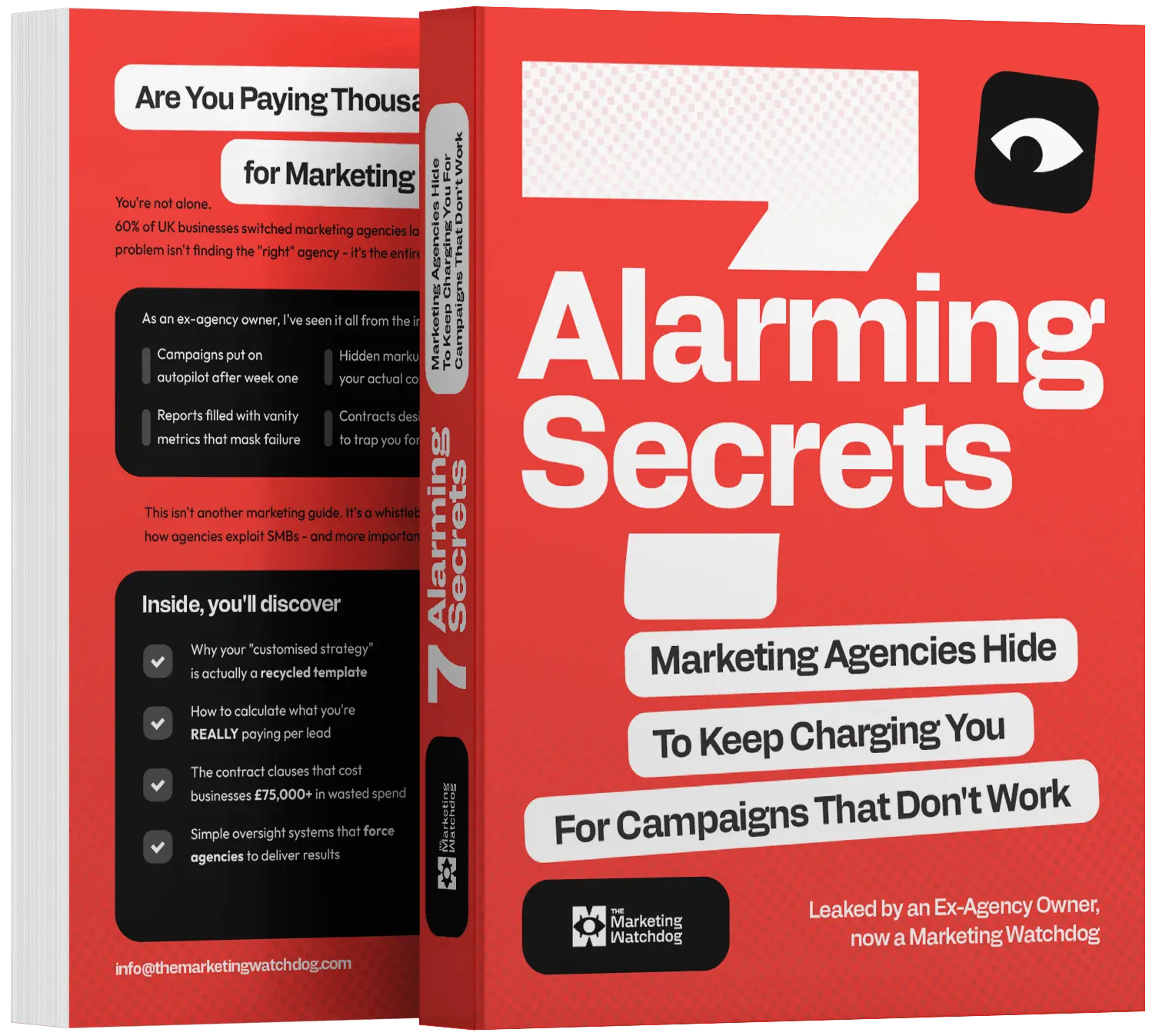
Warning Sign #5: Junior Staff Execution
What it looks like: The experienced professionals who sold you have disappeared, replaced by inexperienced juniors who struggle to answer basic questions about your industry or campaign strategy.
Your pitch meeting featured the agency’s senior strategist and founder. They impressed you with their experience, their case studies, their understanding of your challenges. After you signed, you never saw them again. Your day-to-day contact is someone who seems to be learning on the job, can’t explain the strategic rationale behind campaign decisions, and struggles to answer questions that go beyond basic reporting.
Why it matters: Agencies often use senior staff to win business, then hand accounts to junior team members to maximise margins. You’re paying premium rates for expert management while receiving entry-level execution.
This isn’t just about experience. Junior staff may lack the knowledge to optimise effectively, the authority to make strategic decisions, or the skills to identify and fix problems before they become expensive.
How to verify: Request the CVs or LinkedIn profiles of everyone working on your account. Ask specifically: “Who will be doing the day-to-day work on our campaigns, and what is their background?” Compare what you were told during the sales process with who actually manages your account.
Learn more: How agencies use A-team to win you and B-team to serve you | Questions that reveal how experienced your account manager really is
Warning Sign #6: Data Access Restrictions
What it looks like: You lack direct admin access to your own advertising accounts, analytics, or complete performance data. Reports are provided in PDF format rather than interactive dashboards.
When you ask to log in to your Google Ads account, you’re told it’s “complicated” or “not necessary.” Your reports arrive as PDFs that you can read but not interrogate. You can’t drill into the data, verify the numbers, or explore performance on your own terms. The agency controls what you see and how you see it.
Why it matters: Data access restrictions serve one purpose: control. When you can’t see raw data, you can’t verify what you’re being told. You can’t identify problems the agency might prefer to hide. You can’t get a second opinion from another professional.
Legitimate agencies have nothing to hide. They welcome client access because they’re confident in their work. Agencies that restrict access are usually protecting themselves, not you.
How to verify: Ask directly: “Will we have full admin access to all advertising accounts and analytics platforms?” If the answer is anything other than an immediate “yes,” ask why. Legitimate reasons are rare.
Learn more: Why your agency won’t give you the login credentials | What happens to your campaign data if you leave
Warning Sign #7: Contract Handcuffs
What it looks like: You’re locked into lengthy notice periods, auto-renewal clauses, or threatened with loss of marketing assets if you try to leave, despite poor performance.
Your contract requires 90 days notice to terminate. It auto-renews for another year unless you notify them during a narrow 30-day window. When you mention concerns about performance, the conversation turns to how difficult and expensive it would be to leave. Your advertising accounts might be in their name. Your data might not transfer easily.
Why it matters: Agencies confident in their performance don’t need contractual barriers to retain clients. Results are the best retention tool. When agencies rely heavily on notice periods, auto-renewal traps, and asset hostage tactics, it suggests they expect clients will want to leave.
From my experience on both sides of the agency relationship, I’ve noticed a clear pattern: the more an agency relies on contractual handcuffs rather than performance to retain clients, the less confident they are in their ability to deliver results.
How to verify: Read your contract carefully. Identify the notice period, any auto-renewal provisions, and what happens to data and assets upon termination. If leaving is designed to be difficult regardless of performance, that design is intentional.
Learn more: What to look for in the fine print before committing | How to leave without losing your data and campaign history
Taking Action on Warning Signs
If you’ve recognised several of these warning signs in your agency relationship, here’s what to do next.
Assess Your Current Situation
Before taking action, document what you’ve observed. Which warning signs are present? How severe are they? What evidence do you have? Understanding the full picture helps you determine the right response.
Not every agency relationship with problems needs to end. Some issues can be addressed through direct conversation and clear expectations. Others indicate fundamental problems that won’t be fixed.
The Conversation to Have
Start with a direct conversation. Share your concerns specifically, not in general terms. “I’ve noticed our campaigns haven’t changed in three months” is more productive than “I’m not happy with results.”
Ask for specific responses: What changes have been made? What’s the plan going forward? What metrics will show improvement, and by when?
A good agency will welcome the conversation. They’ll provide specific answers, acknowledge legitimate concerns, and commit to concrete improvements. A problematic agency will deflect, become defensive, or offer vague assurances without substance.
When to Escalate
If direct conversation doesn’t produce meaningful change, escalate to agency leadership. If that doesn’t work, consider your options for exit.
Document everything. Save copies of all communications, reports, and data you have access to. If the relationship ends poorly, documentation matters.
The Independent Assessment Option
Sometimes you need an outside perspective. An independent assessment can verify whether your concerns are justified, identify issues you might have missed, and provide specific recommendations for addressing problems.
An independent professional can access your advertising platforms directly, assess performance objectively, and give you an honest view of whether your agency is delivering value.
Trust Your Instincts
Here’s the truth most business owners learn too late: if something feels wrong with your agency relationship, it probably is.
You don’t need to be a marketing expert to recognise when you’re not getting value. The discomfort you feel when reading reports you don’t understand, the frustration when questions aren’t answered directly, the sense that you’re paying for more than you’re receiving, these instincts exist for a reason.
The warning signs I’ve outlined are common because the practices behind them are common. Agencies that operate this way rely on client uncertainty, on the assumption that you can’t really evaluate their work.
You can. You just need to know what to look for.
If you’ve recognised these patterns in your agency relationship, don’t wait for things to improve on their own. They rarely do. Take action now: have the conversation, request the access, demand the transparency you deserve.
Your marketing budget is too important to waste on agencies that aren’t earning it.
Get an Independent Assessment
Find Out What’s Really Happening With Your Marketing
I’ll review your agency relationship, assess performance against industry benchmarks, and tell you honestly whether you’re getting value.
What You’ll Receive:
- Assessment of all 7 warning sign areas
- Direct platform access review
- Performance analysis against your actual business goals
- Clear recommendations for next steps
No obligation. No sales pitch. Just an honest evaluation of where you stand.
Request Your Free Agency Assessment →
This post is part of a comprehensive series on marketing audit guide. For the complete guide to protecting your marketing investment, download my free ebook: 7 Alarming Secrets Marketing Agencies Hide.
Stop Guessing. Start Knowing.
Get your free marketing assessment and find out what's really happening with your agency spend.
Get in Touch →